AEO For Ecommerce: How to Get Cited by AI Before Shoppers Decide
What ChatGPT, Perplexity and Google AI actually read on a product page, why the shopper they send converts better, and what an AI agent needs before it can buy from your store. Sourced figures, no projections.
AEO for ecommerce is the work of making your product data, schema and off-site signals readable and trustworthy enough that ChatGPT, Perplexity, Gemini, Claude and Google AI Overviews name your products when a shopper asks a purchase question. It does not replace SEO: it decides whether you are one of the two or three names the assistant says before any click happens.
- Traffic to US retail sites from generative AI tools grew 693.4% year over year in the 2025 holiday season [1].
- Those AI-referred shoppers converted 31% more than visitors from other channels and were 33% less likely to bounce [2].
- AI and agents influenced $262 billion, 20% of global retail sales, over the same holiday period [4].
- 68% of Google searches in the first four months of 2026 ended without a click to any website [6].
- What to measure: across a fixed set of purchase questions and engines, how often your products are cited, and which sources the engine used instead of you.
Open your best-selling product page the way an AI crawler opens it: one request, no JavaScript, no cookies accepted. The price is written into the page by a script that never runs. The description is the manufacturer's paragraph, identical to the one on forty other stores. The size chart and the reviews live in widgets that load after the page. What is left is a title, one image and a heading. That is the page ChatGPT, Perplexity and Google's AI features are asked to recommend from, and they are being asked more often, by shoppers who convert better when they arrive.
AEO for ecommerce (Answer Engine Optimization) is the discipline of structuring product content, schema markup and off-site signals so that AI systems cite your products when shoppers ask purchase questions. It does not replace SEO. It is the citation layer that decides whether your brand appears inside the answer, where a growing share of purchase decisions is made.
What the assistant actually reads on a product page
Two readers visit your store on behalf of an AI engine. The first is a crawler such as GPTBot, PerplexityBot or ClaudeBot: it fetches the raw HTML and moves on. The second is the live fetch a chatbot makes when it opens a URL to answer one question. Both extract mainly from the visible, rendered content. Neither waits for a JavaScript bundle, clicks a cookie banner or expands a tab.
So the first test is blunt. Product name, description, specifications, price, availability and reviews must be present in the HTML the server returns. If any of those arrives only after a script executes, that field does not exist for the model. It is not ranked lower. It is absent from the answer set. A ranking penalty degrades a position; an unreadable page produces a complete absence.
The second layer is structured data. Every product page should carry Product schema with at least name, description, image, brand, SKU or GTIN, offers (with price, priceCurrency, availability) and aggregateRating where reviews exist. Check it with Google's Rich Results Test. The rule that matters more than completeness is consistency: every property in the JSON-LD must also appear in the visible page. A schema price that is not on the page is a Google policy violation. An Organization founding date that contradicts the About page tells a model that reads both that the source is unreliable.
The third layer is the copy itself. Manufacturer descriptions are syndicated across dozens or hundreds of retailers. A model that reads the same paragraph on every store has no reason to name yours; no single retailer is identifiable as the source. Each product page needs one original layer: a brand-specific description, a use case the manufacturer does not mention, a synthesis of what customers say, or a technical detail the syndicated copy omits. That is the minimum bar for being distinguishable.
A fourth failure shows up in server logs rather than on the page. When an assistant has not read your catalog, it still sends the shopper somewhere, and it guesses a URL from the product name; the share of connected stores that receive such requests is in the capsule above. A bare 404 ends that visit. A retired product URL that redirects to the current product or its category keeps it.
The buyer who arrives from an answer is worth more than the one from a click
The scale is not intuitive until the figures sit side by side. During the 2025 holiday season, traffic to US retail sites from generative AI tools grew 693.4% year over year, according to Adobe Analytics, which draws on more than 1 trillion visits to US retail sites [1].
Source: Adobe Analytics, November–December 2025 [1][2]. Adobe tracks more than 1 trillion visits to US retail sites.
The same data, as reported by Digital Commerce 360, shows those visitors converting 31% more than visitors from other sources, bouncing 33% less, spending 45% more time on site and generating 254% more revenue per visit than a year earlier [2]. They are not browsing. They arrive with an intent the answer already shaped. On the consumer side, in Adobe's survey of 5,000 US consumers, 39% had already used generative AI for online shopping and 53% planned to during 2025 [3].
Shopify's platform data points the same way. In Q1 2026, referral sessions from AI chatbots to Shopify storefronts grew more than 8x year over year, AI-referred orders grew nearly 13x, and those shoppers converted at nearly 50% higher rates than organic search visitors, with 14% higher average order values [5].
Source: Shopify, Q1 2026 commerce data [5]. AI-referred shoppers also convert at nearly 50% higher rates than organic search.
Meanwhile the click is thinning out. In the first four months of 2026, 68.01% of US Google searches ended without a click to any website, per SparkToro's analysis of Similarweb clickstream data [6]. A study of 20.9 million shopping keywords found that 14% now trigger a Google AI Overview, a 5.6x increase in the four months to March 2026 [7]. The results page is no longer where the highest-intent decision is made. The answer is.
Four questions, two gates
Shoppers ask assistants differently from how they search Google: longer, more specific, closer to a decision. The questions cluster into four groups.
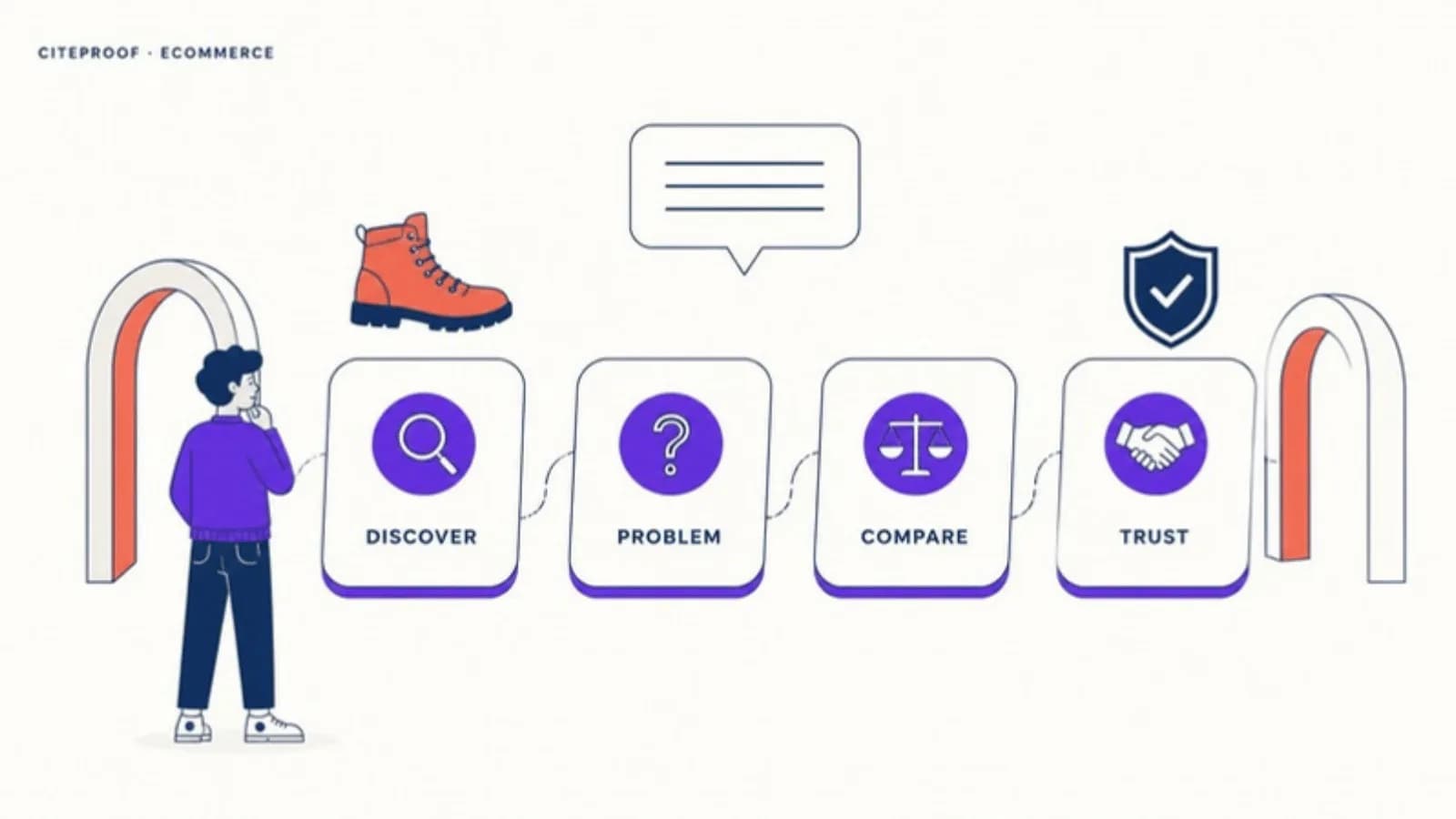
Discovery is the highest-intent group: "best [category] under $X for [use case]", "[Brand A] vs [Brand B] for [need]", "what should I look for when buying [category]?". Problem questions come earlier: "my [device] keeps doing X, what should I buy?", "is [material] actually worth it?". Comparison questions sit in the middle: pros and cons of a product, three products compared on one specification, which one has the best reviews for one attribute. Trust questions close the loop: "is [brand] legit?", "what do real customers say?", "are there complaints about [brand]?".
Discovery and trust are the opening and closing gates of the purchase. A brand named while the shopper discovers options and absent when they verify loses the sale at the last step. A brand absent from both is not in the consideration set at all. Check your product and category pages against those two gates first; the middle two clusters are where buying guides and comparison pages earn their place.
Product page, category page, guide: what each one owes the model
Fix the foundation first: an access block or a broken schema makes every later move invisible.
The product page owes the model schema that matches the page, an original description, and a short FAQ. AI engines are built to answer questions, so a page with explicit questions and direct factual answers maps onto how a model composes a reply; FAQPage markup tells it that is what the section is. Write four to eight entries around real purchase questions. "Is this boot waterproof or water-resistant?" is useful. "Why is this the best boot on the market?" gives the model nothing it can use in a neutral comparison.
The category page owes the model the differences between the products it lists, and ten to fifteen FAQ entries that answer the problem and comparison questions for the whole range. This is the page a discovery question most often lands on, and the one most stores leave as a grid with no text.
The buying guide owes the model depth. Ten substantive guides about one category outperform fifty shallow articles on loosely related topics, because depth compounds into the topical authority a model recognizes. Use clear headings, numbered steps where sequence matters, comparison tables with factual values, sourced data points. Then add what nobody else can publish: internal survey results, anonymized order data on how the product is used, your own testing method. A page that only repeats the consensus of the category gives the model no reason to cite it over a dozen equally generic alternatives.
Access cuts across all three. Audit robots.txt and WAF rules explicitly for GPTBot, PerplexityBot and ClaudeBot. Rules written before these bots existed, aggressive bot management in Cloudflare or a similar WAF, and cookie consent that hides content from non-interactive visitors each produce the same result: removal from the answer.
Off-site is the layer the model reads when it decides whether to trust you: reviews on Google, Trustpilot and Amazon where applicable, Reddit threads in your category, editorial placements in publications your shoppers read. A product with strong, recent, detailed reviews on trusted platforms has a structural advantage over one with sparse or dated coverage.
When the agent buys instead of the shopper
The next reader of your product page is not a person at all. Salesforce estimated that AI and agents drove 20% of global retail sales and $262 billion in revenue during the 2025 holiday season, and that shoppers referred from AI-powered search converted nine times more often than those arriving from social media [4]. Morgan Stanley puts "agentic shoppers" at $190 billion to $385 billion of US ecommerce spending by 2030, a 10% to 20% share, and notes that roughly 23% of Americans had already bought something via AI in the past month [8]. Apart from that outlook, every figure in this article describes what has already happened.
An agent that compares and buys on a shopper's behalf does not read your hero banner. It reads fields: price, currency, availability, shipping cost and time, return conditions, variant identifiers, a GTIN that lets it match your listing against others. It needs all of them machine-readable, with the same values on the page, in the schema and in any feed you syndicate. A price that differs between schema and page is not a hygiene issue for an agent; it is a reason to pick the competitor whose numbers agree.
So the product page work above is not preparation for a future channel; it is the same data the agent will check. A store whose offers, stock and policies are complete and consistent in structured form is legible to a person, a chatbot and an agent at once. A store that keeps its policies in a PDF and its stock in a script is legible to none of them.
Where the work gets undone
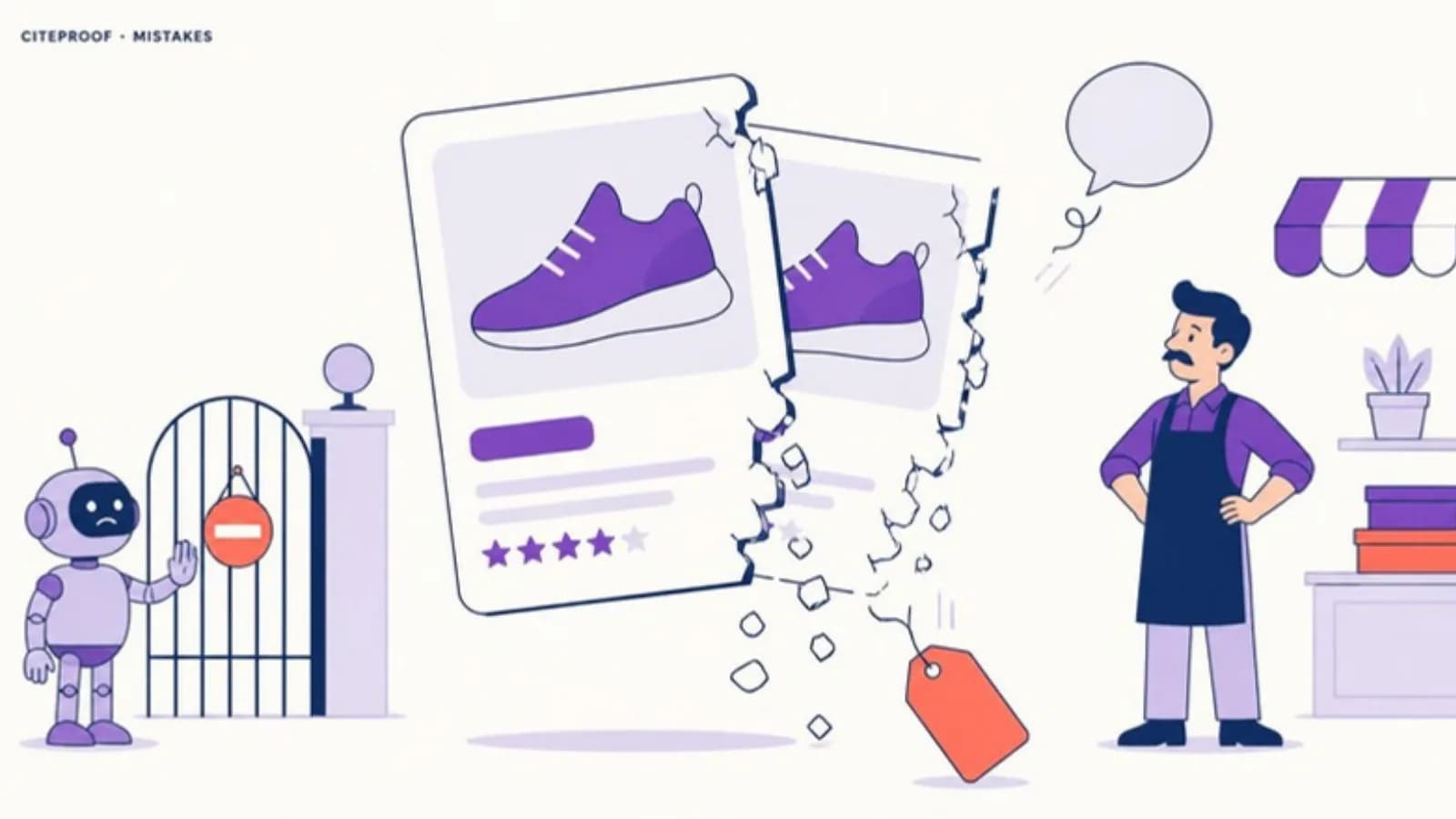
The most common regression is measuring the wrong thing. SEO measures position in an index; AEO measures citation in a generated answer. A team tracking keyword rankings will misread what is happening, because a page-one ranking and a complete absence from every AI answer about the category coexist on most mid-market stores today.
The second is drift between schema and page: a schema fix made in January, contradicted by a price change made in April through a different tool. Put schema consistency in the release checklist for any change to price, availability or product name.
The third is the crawler block nobody remembers writing. Most ecommerce robots.txt files predate GPTBot, PerplexityBot and ClaudeBot, and WAF rate limits treat an AI crawler like any other automated request. Re-run the access audit whenever the CDN or bot management configuration changes.
The fourth is the return of manufacturer copy. New SKUs arrive with the supplier's text and the original layer is not applied to them. Make the original description a required field for a product to go live, not a project done once.
The last is abandoning SEO because AEO is growing. Google's AI Overviews are built on indexed content, so a strong SEO foundation helps rather than hurts. The 68% zero-click share still means roughly a third of Google searches send a click [6], and those clicks go disproportionately to high-ranking results. AEO is an additional layer on top of a working SEO operation, not a replacement for it.
Knowing whether it works before the traffic shows up
Citation precedes traffic by weeks or months, so wait for analytics and you learn late. The leading indicator is direct: a fixed set of purchase questions from the four clusters above, written for your category, run every month on ChatGPT, Perplexity, Gemini, Claude and Google AI Overviews, with a record of who is cited and which sources the answer used. From that list you see whether a marketplace or a direct competitor is named in your place, and which page to fix first. Pair it with a baseline of schema coverage, crawler access and FAQ markup, so each fix can be matched to a change in the citations. CiteProof runs that question set and that baseline for you, and counts a fix as done only once it is verified live and readable by the engines.
Find out exactly where your ecommerce store stands in AI search — in 24 hours.
The CiteProof free scan audits your product schema, FAQ structured data, AI crawler accessibility, and off-site signal gaps. You get a prioritized report with specific, fixable findings — not a generic score.
Verified, not promised.
Frequently Asked Questions
What is the difference between AEO and GEO for ecommerce?
AEO (Answer Engine Optimization) and GEO (Generative Engine Optimization) are closely related and often used interchangeably. AEO tends to focus on the content and markup that make a page citable in direct AI answers; GEO tends to emphasize the off-site consensus layer of digital PR, third-party mentions and review platforms. For a store both apply, and the practical moves are the same: schema, FAQ content, topical depth, crawler access and off-site signal.
Which AI systems should I prioritize for ecommerce AEO?
Google AI Overviews remains the highest-volume priority for most stores because it sits inside the dominant search engine and now appears on 14% of shopping queries [7]. ChatGPT, including its shopping features, is second on user volume, and Perplexity is used for research-heavy product questions. The structural requirements are shared, so clean schema, open crawling, strong FAQ markup and topical authority improve results across all of them at once.
How long does it take to see results from AEO optimization?
Schema fixes and crawler access changes can show up in citations within weeks, once the engines re-crawl the pages on their normal cycle. FAQ markup changes often show in Google AI Overviews within four to eight weeks. Topical authority from buying guides compounds over months, and off-site work through reviews and PR has no end date. Expect a three-to-six-month horizon for portfolio-wide improvement.
Can small ecommerce stores compete with large retailers on AEO?
Yes. Large retailers often run sprawling catalogs with inconsistent schema, manufacturer copy across thousands of SKUs and setups that block AI crawlers by accident. A focused store with clean schema across a tighter range, deep guides in one category and genuine off-site signal can outperform them in AI answers for specific question clusters. The mechanism rewards depth and credibility, not size.
Do product reviews actually influence whether an AI cites my brand?
Yes, in two ways. Reviews on third-party platforms such as Google, Trustpilot and specialized industry sites are part of the off-site signal a model reads when it judges brand credibility, and recent, detailed reviews weigh more than sparse or dated ones. On the page, review schema (aggregateRating, reviewCount) tells the model that your product data is validated by real customers, which matters most for trust questions.
Is there a way to measure whether AEO is working before the traffic shows up in analytics?
Yes. Citation monitoring tracks whether your brand, product names or category content appears in AI answers for a fixed set of target questions across ChatGPT, Perplexity and Google AI Overviews. It moves weeks or months before traffic does. A technical audit of schema coverage, crawler access and FAQ markup gives the baseline to track fixes against.
Sources
- [1] Adobe: Holiday Shopping Season Drove a Record $257.8 Billion Online with Consumers Embracing Generative AI Tools · Adobe · January 2026 · accessed 2026-09-29
- [2] Generative AI shifts online holiday shopping traffic in 2025 · Digital Commerce 360 on Adobe Analytics data · January 2026 · accessed 2026-09-29
- [3] Adobe Analytics: Traffic to U.S. Retail Websites from Generative AI Sources Jumps 1,200 Percent · Adobe · March 2025 · accessed 2026-09-29
- [4] Salesforce Reveals 2025 Holiday Shopping Data · Salesforce · January 2026 · accessed 2026-09-29
- [5] AI-referred shoppers convert better and spend more: What Shopify's early data shows · Shopify · May 2026 · accessed 2026-09-29
- [6] In 2026, Less than One Third of Google Searches Still Send a Click · SparkToro on Similarweb data · June 2026 · accessed 2026-09-29
- [7] AI Overviews Now Appear on 14% of Shopping Queries, Up 5.6x in 4 Months (Study of 20.9M SERPs) · 180 Marketing (formerly Visibility Labs), Ahrefs data · March 2026 · accessed 2026-09-29
- [8] Agentic Commerce Impact Could Reach $385 Billion by 2030 · Morgan Stanley · December 2025 · accessed 2026-09-29
Read next
- AEO · Analytics & ConversionLLM Traffic Converts Better Than Organic: ChatGPT, Perplexity, Gemini Data
- AEO · B2B StrategyReddit and AI Citations: What the Data Really Says (B2B Playbook 2026)
- AEO · E-CommerceAEO for Shopify: How to Get Found by ChatGPT in 2026
CiteProof tracks your brand's visibility across AI answer engines and tells you what to change to get cited. With one rule: the score only moves up after the Verify Bot confirms the fix is actually live.