AEO for Shopify: How to Get Found by ChatGPT in 2026
How a Shopify store gets recommended by ChatGPT, Perplexity and Gemini: the crawlers your robots.txt must let in, the product data Shopify Catalog syndicates, the Merchant Center feed, and the FAQ and review text an assistant can quote.
AEO for Shopify means structuring your product data, schema markup, editorial content and reviews so that ChatGPT, Perplexity, Gemini and Claude can parse, trust and cite your store when a buyer asks a purchase question. Shopify's Agentic Storefronts and Catalog provide the plumbing; whether you get named depends on the crawlers you let in and the quality of the data you feed them.
- Referral sessions from AI chatbots to Shopify storefronts grew more than 8x year over year in Q1 2026, and AI-referred orders nearly 13x [1].
- AI searches powered by Shopify Catalog convert at 2x the rate of searches built on scraped data [3].
- In March 2026, AI traffic to US retailers converted 42% better than non-AI traffic, after converting 38% worse a year earlier [5].
- ChatGPT's share of B2B AI referrals fell from 89% to about 63% in eight months, while Claude rose from 1.4% to 18.5% [6].
- What to measure: for a fixed set of purchase questions, whether your store is cited by ChatGPT, Perplexity, Gemini and Claude, and which sources the answer used instead of yours.
Every Shopify store has a robots.txt, and most merchants have never opened theirs. The file lists which automated visitors may read which pages, and it is the first thing a crawler working for ChatGPT, Perplexity or Claude checks before it reads a single product. A marketplace decides in its own file whether those crawlers may read its listings; if it says no, an assistant answering "best minimalist wallet under $50" cannot look there. It can look at your store, if your store lets it. That is a rare advantage for a merchant who sells on a marketplace and on Shopify, and the share of connected stores that give it away with a blocking rule is in the capsule above.
AEO for Shopify — the short answer: Answer Engine Optimization on Shopify means structuring product data, schema markup, editorial content and reviews so that ChatGPT, Perplexity, Gemini and Claude can parse, trust and cite your store when a buyer asks a purchase question. Shopify provides the infrastructure (Agentic Storefronts, Catalog syndication). You provide the quality signal.
The door a marketplace can close and your store can leave open
The check takes five minutes. Open yourstore.com/robots.txt and make sure none of these user agents carries a Disallow: ChatGPT-User and OAI-SearchBot (the fetchers ChatGPT uses to answer in real time), GPTBot, PerplexityBot, ClaudeBot. On Shopify the file is edited through the robots.txt.liquid template; a rule added years ago against "bots" in general, or a bot-management setting at the CDN, blocks these crawlers as readily as malicious ones. If the model cannot read the store, the store is not ranked lower. It is missing from the answer.
The door matters more than a year ago because of what sits behind it. On March 24, 2026, Shopify announced that "starting this week" millions of merchants could sell to ChatGPT users through Agentic Storefronts, with products discoverable in ChatGPT by default, no separate integration, no app, and no transaction fee beyond standard processing rates [2]. The channels Shopify lists out of the box are ChatGPT, Microsoft Copilot, AI Mode in Google Search and the Gemini app [2].
Automatic is not the same as verified. Go to Settings → Sales Channels → Agentic Storefronts and confirm the store is active on each channel. Discovery through scraping or through Shopify Catalog happens whether or not you act. Native selling, where the buyer completes the purchase inside the chat, requires Agentic Storefronts enabled and product data that meets Shopify's quality threshold. Neither is met by a store whose robots.txt keeps the crawler out.
What an AI-referred order is worth on Shopify, and which engine sends it
Shopify's data for Q1 2026 shows referral sessions from AI chatbots to storefronts up more than 8x year over year, AI-referred orders up nearly 13x, and those shoppers converting at nearly 50% higher rates than organic search visitors, with 14% higher average order values [1].
Source: Shopify, Q1 2026 commerce data [1]. AI-referred shoppers convert at nearly 50% higher rates and carry 14% higher average order values than organic search.
The curve is the same outside Shopify. Adobe Analytics, which covers more than one trillion visits to US retail sites, recorded a 693.4% year-over-year increase in traffic from generative AI tools during the 2025 holiday season [4]. The quality of that traffic flipped within a year: in March 2026, visitors from AI sources converted 42% better than non-AI traffic, a channel that had converted 38% worse in March 2025, over a quarter in which AI traffic to US retailers rose 393% [5]. These buyers arrive with a recommendation formed. If it names a competitor, the sale is over before your store is opened.
Which engine forms the recommendation is changing fast. Goodie's AI Search Market Share Report (Wave 2, May 2026) found ChatGPT's share of B2B AI referrals fell from 89% in August 2025 to 62.6% by March–April 2026, while Claude went from 1.4% to 18.5%, Gemini quadrupled to 10.6% and Perplexity more than doubled to 7.3% [6].
Source: Goodie, AI Search Market Share Report, Wave 2, brand-averaged GA4 referral data, August 2025 – May 2026 [6].
A robots.txt that admits only OpenAI's crawlers, or a data setup tuned to one engine's current preferences, is a single point of failure. Each engine crawls differently, but all of them read the same product page, the same schema and the same feed. Build once for all of them.
Complete product data is the whole game
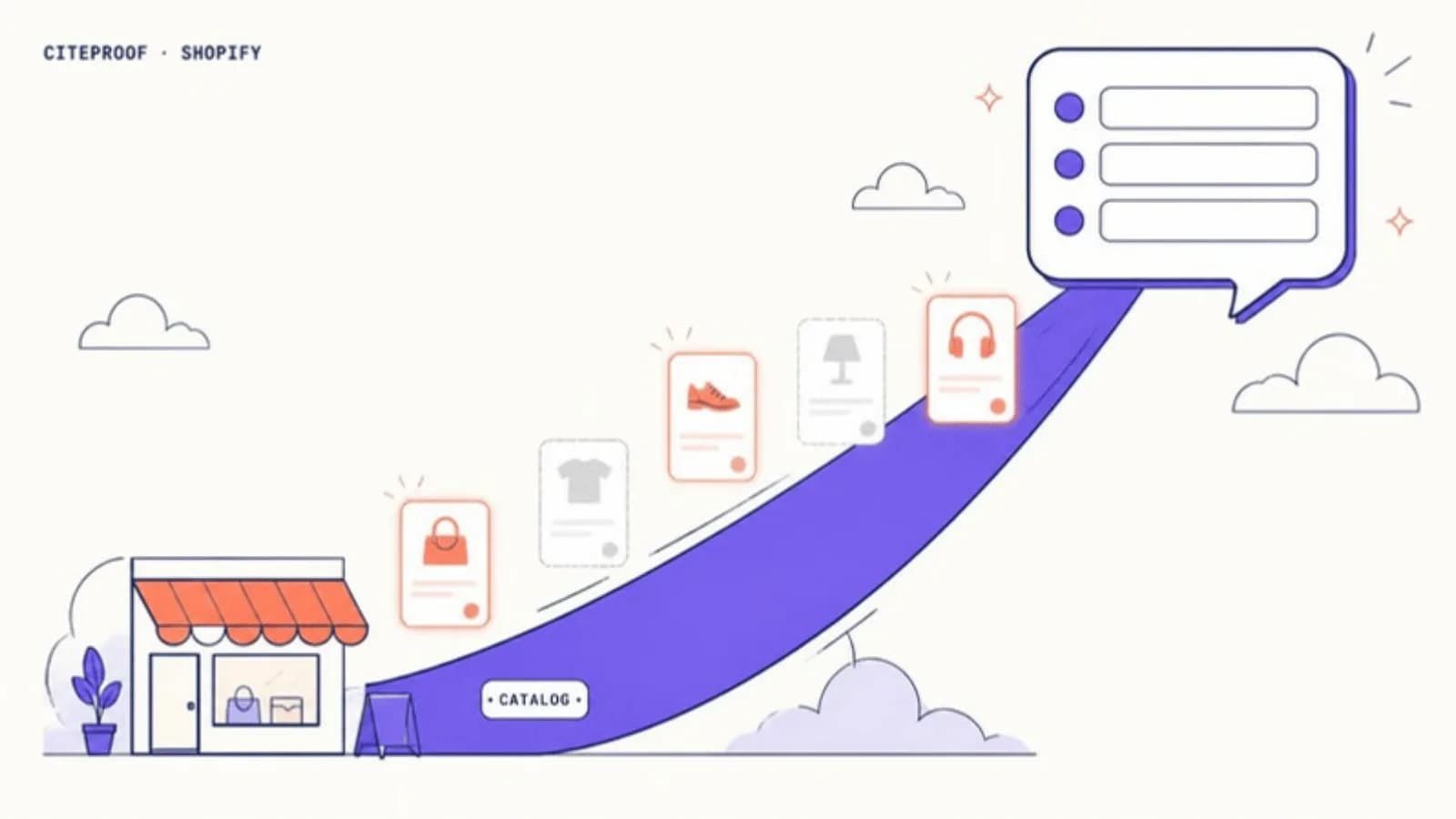
Shopify Catalog syndicates product information across every connected AI platform: titles, descriptions, images, pricing, inventory, shipping. It syndicates what you give it. Shopify's Spring '26 Edition reported that AI searches powered by Catalog convert at 2x the rate of searches built on scraped data [3], and stated the priority in one line: "clean, structured data is easier for agents to read and surface accurately, so your products show up complete and current right when someone is ready to buy" [3]. The platform is the highway. The merchant supplies the signal, and a supplier's paragraph under a vague title is not one.
Audit every product against five questions. Does the title name the product specifically, with material, use case or defining feature? "Merino Wool Crew Neck Sweater — Unisex, Heavyweight" beats "Classic Sweater" on every engine. Does the description answer at least three pre-purchase questions from your category (for bedding: material, thread count, care, which sleeper it suits)? Are all variants populated with accurate inventory? Are specs in structured fields rather than buried in a paragraph? Is every field consistent with every other, so a description saying "organic cotton" is matched by a material field saying the same?
When an engine cannot parse a store's data, because titles are vague, variants incomplete or fields contradictory, it does not fail gracefully. It fills the gap with whatever it can find: competitor content, a generic category description, nothing. That is the citation vacuum, and the merchant never sees it happen. Generic supplier language is its most common cause on Shopify. Rewrite it, starting with the products that carry the most revenue.
The questions buyers bring to the chat
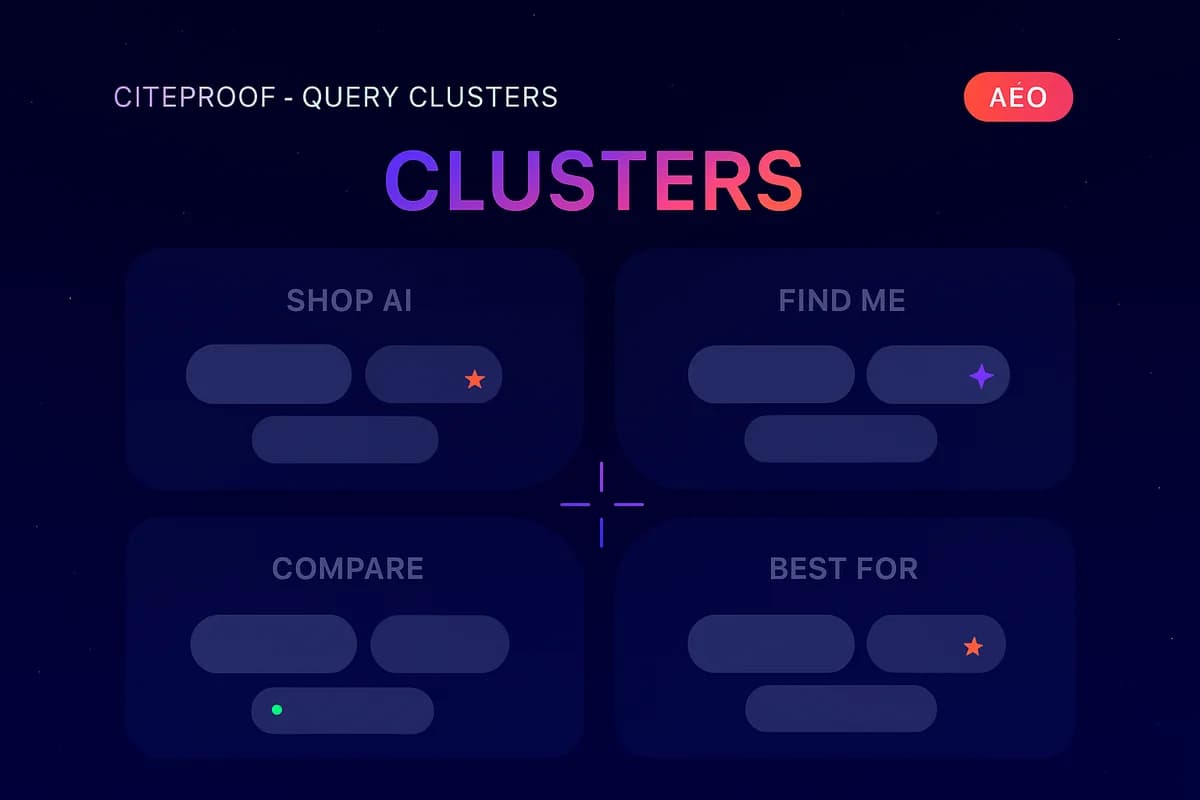
Four kinds of question reach the assistants about products like yours, and each lands on a different part of the store.
Commercial discovery ("best [category] under $X for [use case]", "where can I buy [product] with fast shipping?", "gift ideas for [person] under $50") is what Agentic Storefronts is built to serve; a citation here can end in an in-chat checkout. It lands on product and collection pages, so the data work above decides it.
Pre-purchase research ("what's the difference between [material A] and [material B]?", "is [product] worth it for [problem]?") happens before the buyer has chosen a product. Being cited here shapes the shortlist. It lands on buying guides and FAQ text.
Comparison ("[Brand A] vs [Brand B], honest comparison", "best alternatives to [popular brand] that ship from the US") is the most contested slot: the engine synthesizes from several brand sources, and the one with the most structured, specific and externally referenced data wins the mention.
Trust and policy ("is [brand] legit?", "what is the return policy?", "does [brand] ship internationally?") decides whether the buyer follows through. A store that cannot be verified on these loses the conversion after it has been recommended. Shipping and returns belong on readable pages and in structured fields, not only in a checkout step.
The Merchant Center feed, and the same numbers everywhere
One of the four channels Shopify lists for Agentic Storefronts is AI Mode in Google Search [2], and Google's shopping surfaces read product data from the Google Merchant Center feed. That feed is usually treated as an ads task, maintained by whoever runs Shopping campaigns and rarely compared with the storefront. For AI answers it is a second copy of your catalog, and it must say what the page says.
The stakes on Google are not small. A study of 20.9 million shopping keywords (Ahrefs data) found that 14% of shopping queries now trigger an AI Overview, roughly one product search in seven, a 5.6x increase in the four months to March 2026 [7]. The organic position you spent years earning may now sit below a summary that never names you, and the product data in that summary comes from the feed and the structured data, not from your ranking.
So the rule is one set of values in three places. Price, availability, product identifier (GTIN or MPN), variant names and shipping conditions in the feed must match the Product schema on the page, which must match the visible content. Shopify's Google & YouTube channel syncs the feed from the same product fields the storefront uses, which makes alignment easy if those fields are complete and impossible if the feed has been patched by hand. An engine that finds two prices for the same product does not average them; it names the store whose numbers agree.
FAQ, reviews and llms.txt: the text an assistant can quote
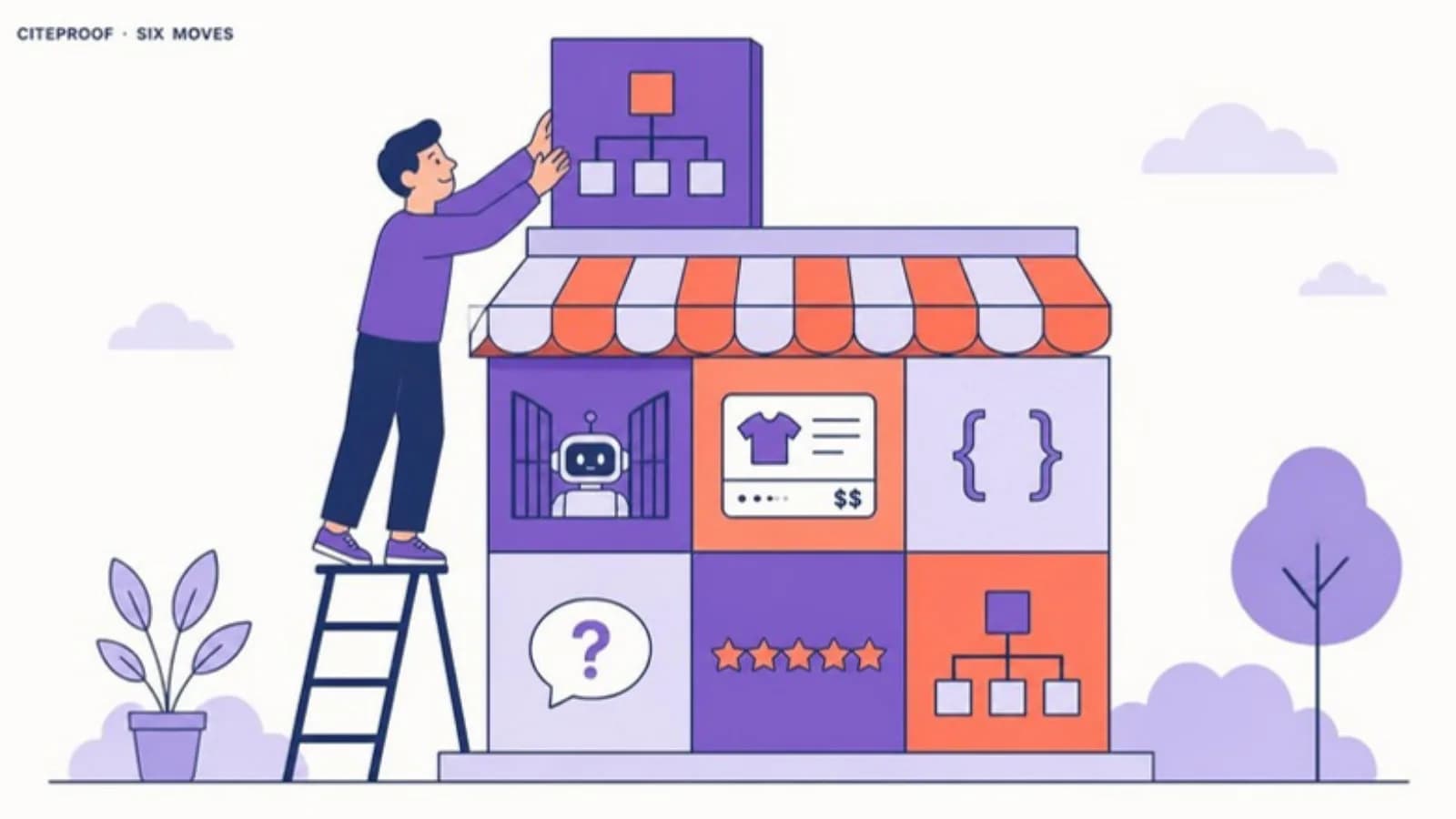
FAQ schema on product pages (the three to five questions buyers ask before buying that product), on collection pages (what separates the products in the category), on comparison pages and on buying guides. Map each entry to a real question from the research or trust cluster. No entry should answer a question nobody asks, and none should contain marketing language; engines favor a verifiable fact over an adjective.
Reviews are natural-language evidence: engines extract use cases, complaints and repeated phrases from them to answer trust and research questions. "Great product, fast shipping, 5 stars" gives a model nothing. "I bought this for my 6-month-old with sensitive skin, used it twice a week for three months, no irritation, the pump lasted the full bottle" gives it a use case, a duration and an outcome. Change the post-purchase prompt to ask what the customer was trying to solve, what they switched from, what they noticed after a period of use. Then show the review text on the page in plain HTML, not only inside a widget a crawler may never render. A 4.9 average from 500 reviews that all say "Love it!" is a good signal for a human and a useless one for an assistant.
llms.txt is a plain file at yourdomain.com/llms.txt that gives AI crawlers an organized map of what the store sells and where the authoritative pages are: a sitemap written for AI agents. Shopify apps such as Avada AEO Optimizer can generate and maintain it, including live inventory status. An engine that can navigate the store efficiently is less likely to fall back on stale scraped data.
Editorial content follows the same rule. A buying guide titled "How to Choose the Best Yoga Mat" with no material data, no measured comparison and no verifiable claim reads as marketing, not reference. Name the certification, cite the wash test, and link each guide to the product pages it discusses, so a citation in the guide is a path to purchase.
The first month, in order
The first two moves are data-quality fixes on pages you already have; the last four build citation surface over time.
Week one: robots.txt, then Agentic Storefronts, then the five products that make the most revenue. On those five, rewrite title and description, fill variants and specs, add FAQ entries, expose review text. Weeks two and three: the Merchant Center feed, aligned with the same fields, and the llms.txt file. Week four: the first run of a fixed set of buyer questions on ChatGPT, Perplexity, Gemini and Claude, noting whether the store is named and which sources the answer used. From there the cycle is monthly, because catalog, stock, reviews and engines all change.
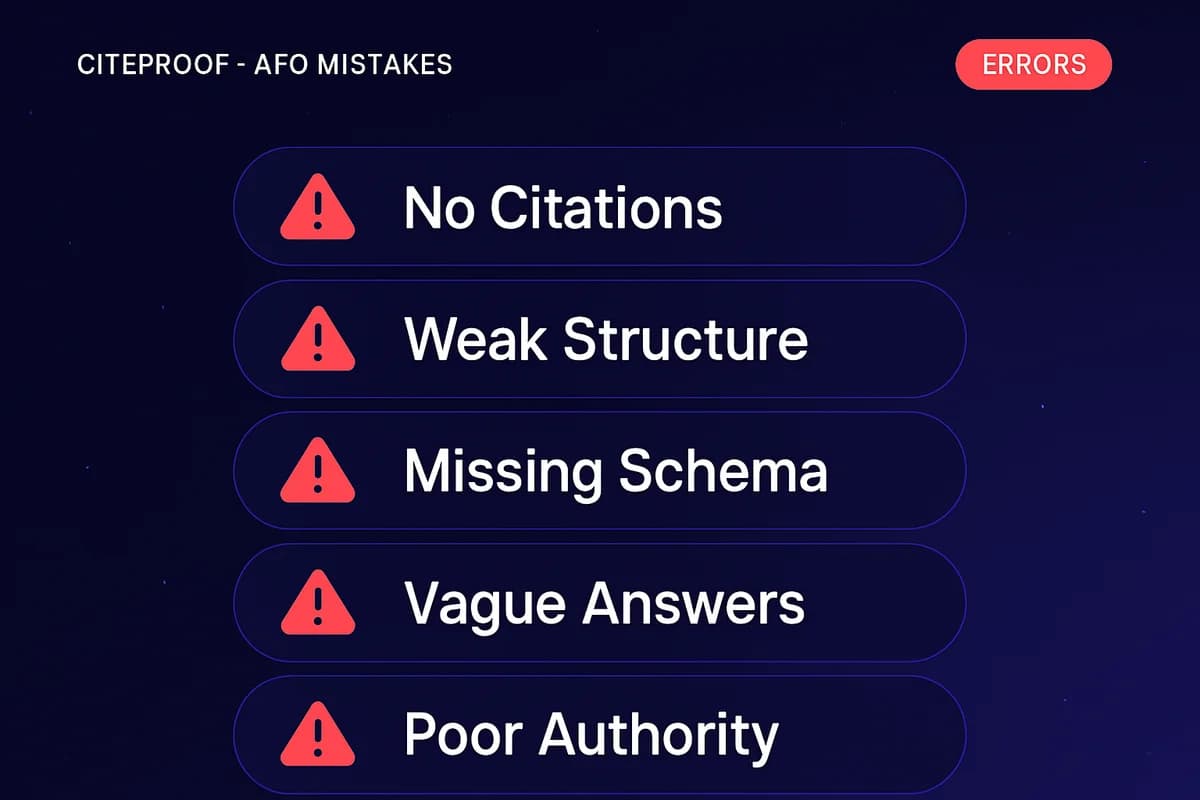
Where stores usually stall, in order: assuming the platform features handle it (they carry the data, they do not improve it); a blocking rule nobody knew about; tuning for ChatGPT alone while its share of referrals falls [6]; guides with no citable fact; reviews collected for a star average rather than for text; and treating all of it as a configuration done once, when schema drifts from the page and llms.txt from the stock within a quarter. None of these needs a budget. They need an inventory: which crawlers are blocked, which fields are missing, which products have no structured text. The CiteProof free scan makes that inventory on your store.
Run a verified Shopify AEO scan — no cost, no obligation
CiteProof audits your Shopify store against the technical and editorial criteria that AI systems use to decide whether to cite your products. You receive a prioritized report of exactly what is creating citation gaps — and what to fix first.
No promises about rankings. No projections about traffic. A verified diagnosis of where you stand today.
Frequently Asked Questions
What is AEO for Shopify, and how is it different from regular Shopify SEO?
Shopify SEO optimizes the store to appear in the ranked list of URLs Google returns for a keyword. AEO optimizes it to be cited in the conversational answers ChatGPT, Perplexity, Gemini and Claude generate. The two share foundations (structured data, content quality, site authority) but diverge in execution: AEO prioritizes crawler access, data completeness, schema specificity and answerable text over keyword density and link acquisition.
Is Shopify Agentic Storefronts enough? Do I still need to do AEO work?
Agentic Storefronts is the connection between the store and the AI shopping interfaces; it is necessary, not sufficient. Catalog-connected AI searches convert at 2x the rate of scraped-data searches [3], but only when the catalog data is complete and consistent. Crawler access, data quality, schema, FAQ and review text still decide whether an engine cites you or a competitor.
Which AI systems should I be optimizing for?
All of the major ones: ChatGPT, Perplexity, Gemini and AI Overviews in Google Search, Claude and Microsoft Copilot. As of March–April 2026, ChatGPT holds roughly 63% of B2B AI referrals but is losing share, while Claude has grown from 1.4% to 18.5% [6]. Since all of them read the same page, schema and feed, tuning for one platform's current preferences is the wrong bet.
How do I know if my Shopify store is currently being cited by AI systems?
Standard analytics do not yet attribute AI referrals reliably; some of the traffic shows as direct or unattributed. Test directly: run your category questions in ChatGPT, Perplexity and Gemini and note whether the store is named and which sources the answer draws on. Repeat monthly with the same questions, and pair it with an audit of the crawler and data criteria the engines apply.
What is llms.txt and do I actually need it for Shopify?
llms.txt is a plain file at the domain root that gives AI crawlers an organized map of the store's products, collections and content, with live inventory status if an app maintains it. It is not mandatory, but without it an engine that cannot navigate the store falls back on scraping, which raises the risk that outdated data represents the store in an answer.
Does AI search help with conversion, or just discovery?
Both. Adobe's data for March 2026 shows AI-referred visitors to US retailers converting 42% better than non-AI traffic [5], and Shopify reports AI-referred shoppers converting at nearly 50% higher rates than organic search [1]. The channel rewards accuracy as much as visibility: a citation with the wrong price, availability or specs fails at checkout even when the store is named.
Sources
- [1] AI-referred shoppers convert better and spend more: What Shopify's early data shows · Shopify · May 2026 · accessed 2026-09-29
- [2] Millions of merchants can sell in AI chats · Shopify · March 2026 · accessed 2026-09-29
- [3] Selling everything, everywhere, all at once: The Spring '26 Edition · Shopify · June 2026 · accessed 2026-09-29
- [4] Adobe: Holiday Shopping Season Drove a Record $257.8 Billion Online with Consumers Embracing Generative AI Tools · Adobe · January 2026 · accessed 2026-09-29
- [5] AI traffic to US retailers rose 393% in Q1, and it's boosting their revenue too · TechCrunch on Adobe Analytics data · April 2026 · accessed 2026-09-29
- [6] 2026 AI Search Traffic Report: ChatGPT's Grip Slipped, Claude & Gemini Are Surging · Goodie · May 2026 · accessed 2026-09-29
- [7] AI Overviews Now Appear on 14% of Shopping Queries, Up 5.6x in 4 Months (Study of 20.9M SERPs) · 180 Marketing (formerly Visibility Labs), Ahrefs data · March 2026 · accessed 2026-09-29
Read next
- AEO · Analytics & ConversionLLM Traffic Converts Better Than Organic: ChatGPT, Perplexity, Gemini Data
- AEO · B2B StrategyReddit and AI Citations: What the Data Really Says (B2B Playbook 2026)
- AEO · EcommerceAEO For Ecommerce: How to Get Cited by AI Before Shoppers Decide
CiteProof tracks your brand's visibility across AI answer engines and tells you what to change to get cited. With one rule: the score only moves up after the Verify Bot confirms the fix is actually live.