How I made a luxury tour operator citable by ChatGPT, Gemini, and Claude
Six AI-sourced leads in four months for a boutique Italian luxury tour operator — across ChatGPT, Gemini and Claude, over $209,000 in declared pipeline. The full method, data, and results.
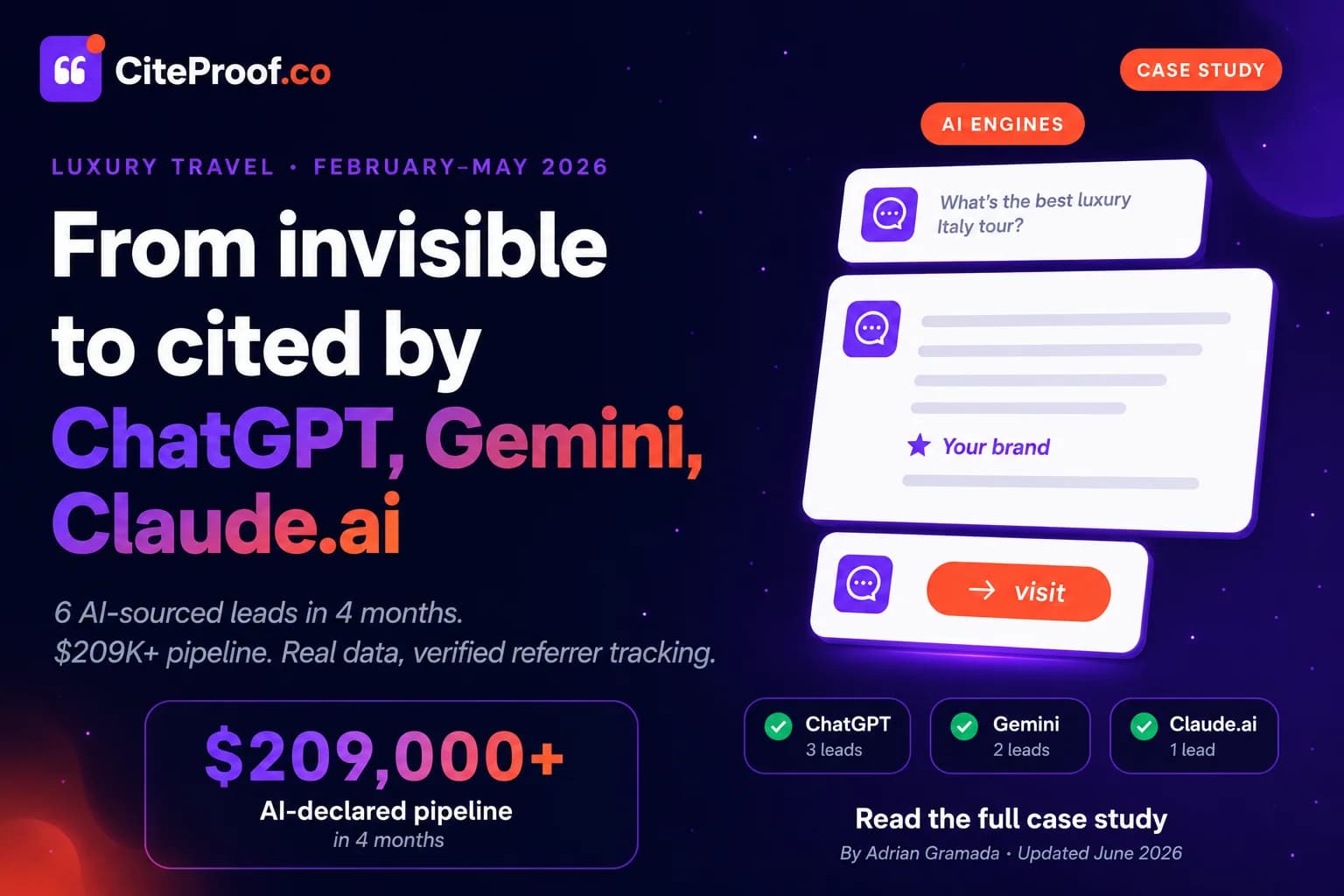
The real-world case of a boutique bespoke travel brand in Italy: from depending almost entirely on brand-name traffic to generating qualified quote requests directly from AI engines. Full method, data, and results — the custom consulting work I did, and the know-how I later codified into CiteProof.co.
Across six months of work on content, technical structure, authority, and link building, an Italian luxury boutique tour operator went from a website that intercepted almost only brand queries to one with doubled organic impressions, a commercial keyword in absolute first position, and most importantly, qualified quote requests arriving directly from ChatGPT, Google Gemini, and Claude.ai. Six AI-sourced leads confirmed in four months, distributed across three different engines, with one single lead estimated at over $57,000 in trip value.
Transparency note: this is a case study of my custom consulting work, not of the CiteProof.co SaaS product. CiteProof is the software I built by codifying the automatable part of this know-how — created for small and medium businesses that can't afford six months of consulting but still want to track and improve their AI visibility. I explain that bridge at the end. This June 2026 update extends the originally tracked two AI leads (February–March) to the additional four that came in through May.
Starting point and audit
The client is a boutique bespoke travel operator, active since 2004, designing luxury itineraries in Italy for affluent American travelers. Excellent product, real access to exclusive experiences, an Italian founder with territorial knowledge hard to replicate. The problem wasn't the offering. It was visibility.
The initial audit, built by cross-referencing Search Console, Semrush, and a full technical scan, painted a clear picture:
- Organic traffic came almost exclusively from brand queries. Commercial keywords — the ones that bring buyers ready to spend — generated no clicks.
- Phrases like luxury italy tours and bespoke vacations italy had dropped 15 to 32 positions in the months before I took over.
- Strategic pages were effectively invisible: the tours page collected one click, the Rome destination page zero.
- Technically, dozens of pages with redirects, eleven 404 errors, and indexing issues were slowing down crawling.
- The backlink profile was significantly weaker than direct competitors in the same tier.
The percentage growth shown in previous reports was real only on paper. Growing 5,000% from 7 clicks per month means nothing. The site relied on organic and ads, with no other channel acting as a safety net.
Why traditional SEO alone wasn't enough
In 2025, the way people search for travel changed. A growing share of the audience doesn't open ten Google tabs anymore: they ask ChatGPT, Perplexity, or Gemini to organize a honeymoon in Tuscany and read the synthesized answer, with the brands the model decides to cite. AI-sourced traffic grew 527% in 2025.
That changes the rules. Ranking isn't enough: you need to become citable. The research backs this with precise numbers:
- 87% of ChatGPT citations match the top Bing results: optimizing for Bing becomes a direct proxy for ChatGPT visibility.
- According to Princeton's GEO study, citing sources increases AI visibility up to 115% for sites in fifth position.
- Reddit appears in 46.7% of Perplexity citations, which also rewards content freshness.
- Answer capsules — concise, self-contained answers immediately after headlines — are the single strongest predictor of citation across 680 million citations analyzed.
- Proprietary data is the second predictor: content with original statistics shows AI visibility 30–40% higher.
- 74% of sources cited by Google AI Overviews are already in the top ten organic results: classic SEO remains the foundation.
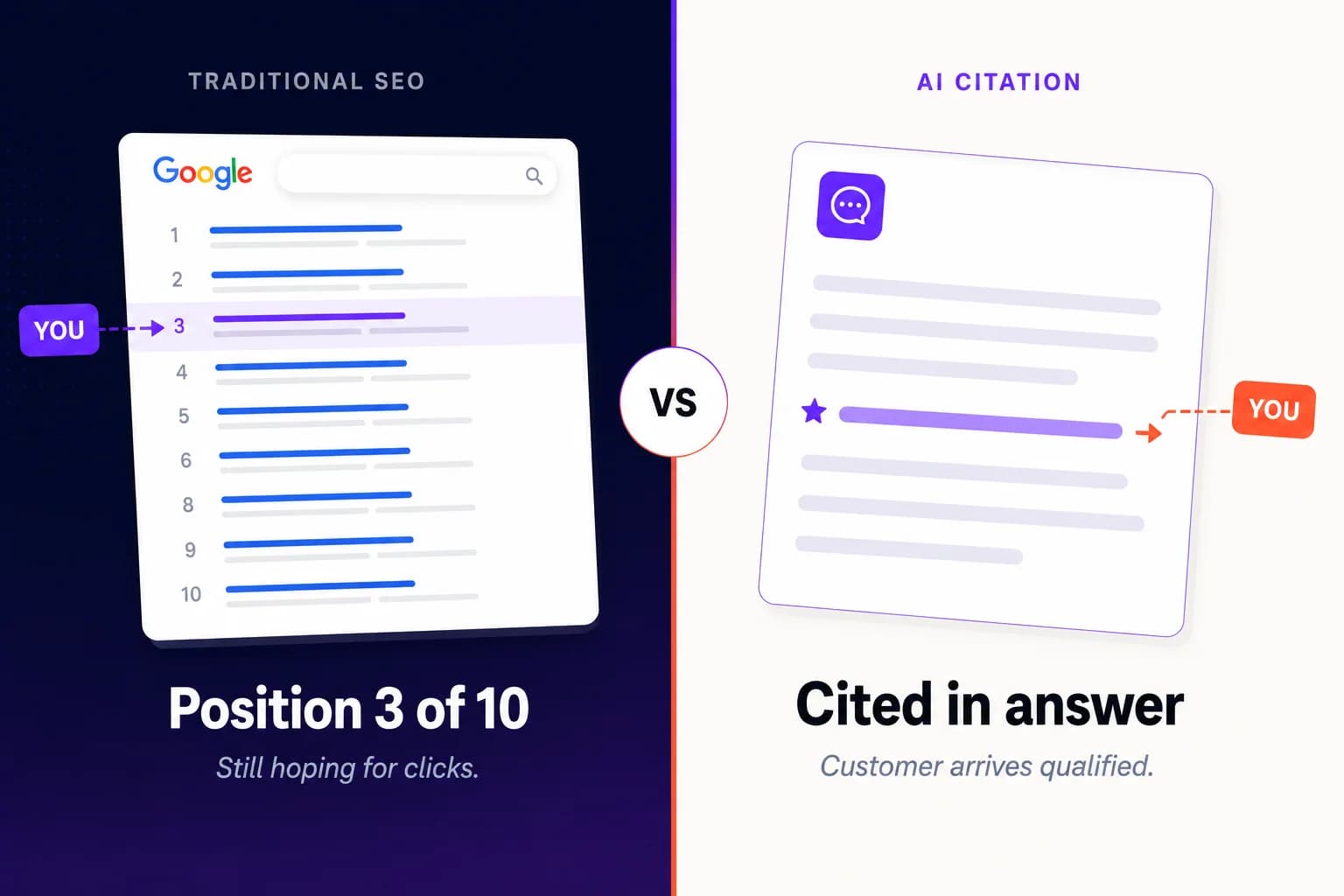
So the strategy wasn't "do more SEO." It was building content that ranks well on Google AND is engineered to be cited by generative engines. Two goals, one system.
The GEO/AEO content system
Every page and every article follows a repeatable structure, designed so both a human reader and a language model find the answer immediately. The pillars:
| Element | Purpose |
|---|---|
| Answer capsule (40–70 words) | Direct answer right after the title, citable as a standalone block by an AI engine. |
| H2s formed as questions | Align content with real queries and voice search. |
| Comparison tables | Structured data easy for models to extract and cite. |
| Quotes with credentials | Signal of direct experience, the trust threshold for AI citability. |
| FAQ with schema markup | Value for Bing, AI citation, and voice search. |
| Specific data and pricing | Concrete numbers a model is compelled to cite if it uses them. |
On top of this structure, I applied a structured prompting framework: Actor, Input, Mission to define intent, and Memory, Assets, Prompt to anchor each text to real data instead of the model's memory. The tone is codified on a consistent profile across the site, with high openness and conscientiousness and low neuroticism: warm but authoritative, never empty promotion. No generic claims, always concrete detail over vagueness.
Production: clusters and pages
I organized production into thematic clusters, each with a hub page, service pages, and supporting articles, connected by disciplined internal linking (one dofollow link per destination URL, the rest nofollow) and closed by a commercial page that collects the inquiry.
| Cluster | What was produced | Outcome |
|---|---|---|
| Destinations | Destination pages for major cities (Rome, Tuscany, Florence, others) | Keyword coverage and linking hub |
| Honeymoon | Honeymoon hub, couples articles, wedding trip cost | High commercial-value cluster, entry of 2 AI leads |
| Family | Articles and dedicated page for family travel | Entry channel for 1 AI lead |
| Corporate retreats | Corporate hub plus leadership and executive retreats pages | First position "leadership retreats italy" |
| Anniversaries and milestones | Commercial pages for couple celebrations | Entry cluster for 3 high-budget AI leads |
In the February–March period alone, eight pages were published or optimized. In parallel, I built two three-step request forms (one generic, one dedicated to corporate retreats) to separate and qualify incoming leads.
The AI detection obstacle
Producing content at volume with AI assistance creates a real risk: detectors recognize it, and content perceived as serially generated loses credibility both with editors and models. The threshold I set myself was staying under 30% AI detection before publication.
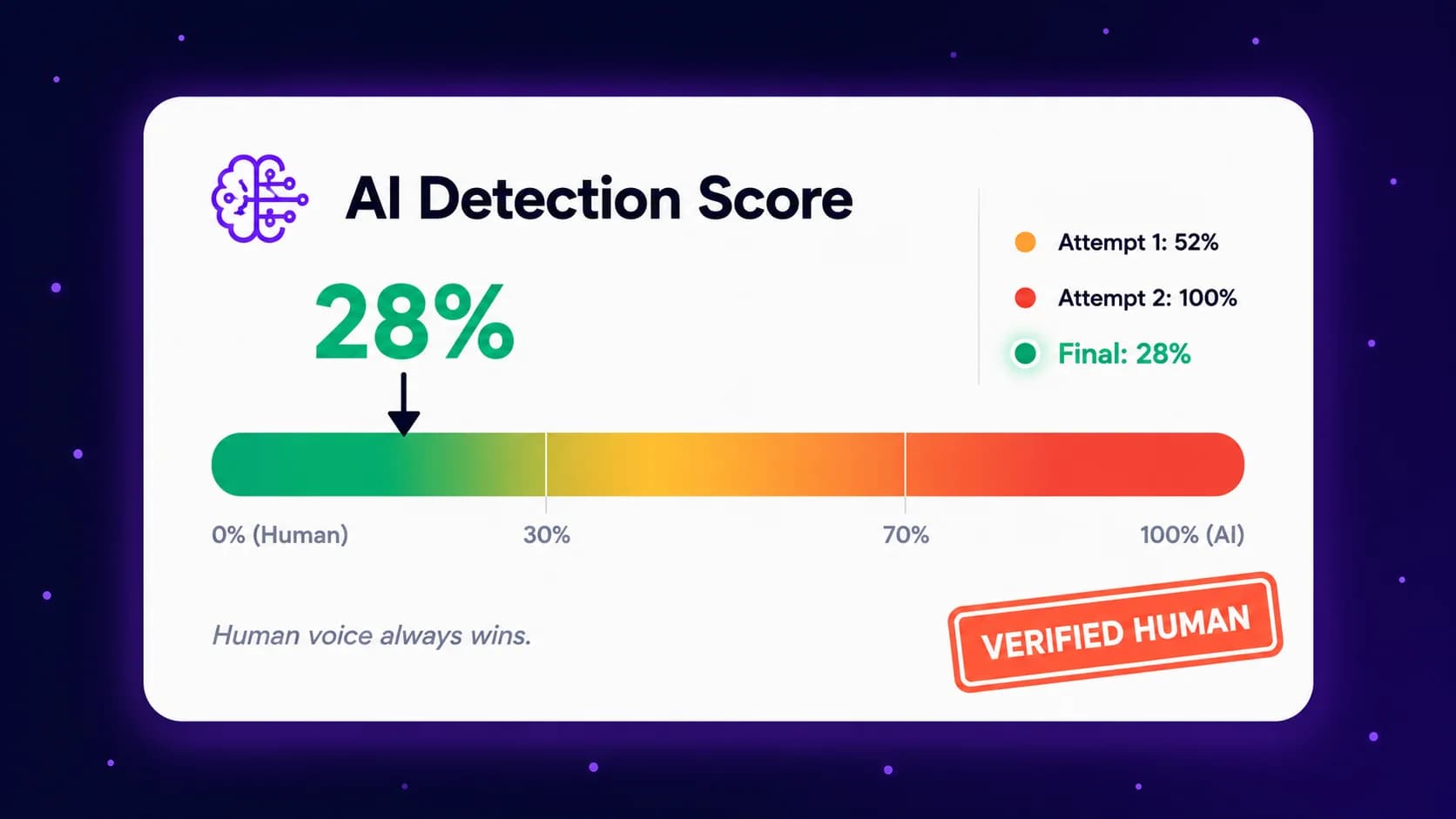
The path wasn't linear, and this is the most useful point of the case study. No stylistic trick changes the probabilistic distribution of tokens: some richer versions went from 52% to 100% AI score, because more text gave the model more signal to work with. The breakthrough came from a precise combination, later codified into a reusable voice document:
- First-person founder voice, with autobiographical anecdotes impossible to generate.
- Named characters with verifiable details (a boat captain, a couple met at a pharmacy) that break the patterns.
- Domain-specific Italian vocabulary (40–60 terms per article) to raise reading complexity without forcing the English register.
- Systematic elimination of AI's statistical signatures: too-regular rhythm, parallel constructions, em dash overuse, missing contractions.
The strategic lesson: useful, quality AI-assisted content isn't penalized by Google, which evaluates E-E-A-T and not detector scores. But real human input, even on just a portion of the text, is the only thing that reliably lowers the score and raises perceived quality. Publishing and iterating beat searching for the perfect version.
Technical work: schema, crawlers, indexing
The best content doesn't get cited if AI engines can't read it or don't trust the source. The technical work covered three fronts:
- Structured data. TouristTrip schema for itineraries, FAQPage for question sections, and article schema with citation, about, and mentions properties to declare sources and entities. Travel sites with complete schema reach a 35% higher organic CTR.
- Crawler access. Verification that GPTBot, PerplexityBot, and Bingbot could access content, with server-side rendering where needed — AI crawlers don't execute complex scripts.
- Technical hygiene. Cleaning up redirects, 404s, and indexing issues from the audit, because every wasted page is crawl budget lost.
Authority: media and link building
E-E-A-T isn't a slogan: it's the trust threshold that decides whether an AI engine cites a source. I worked this front in two directions.
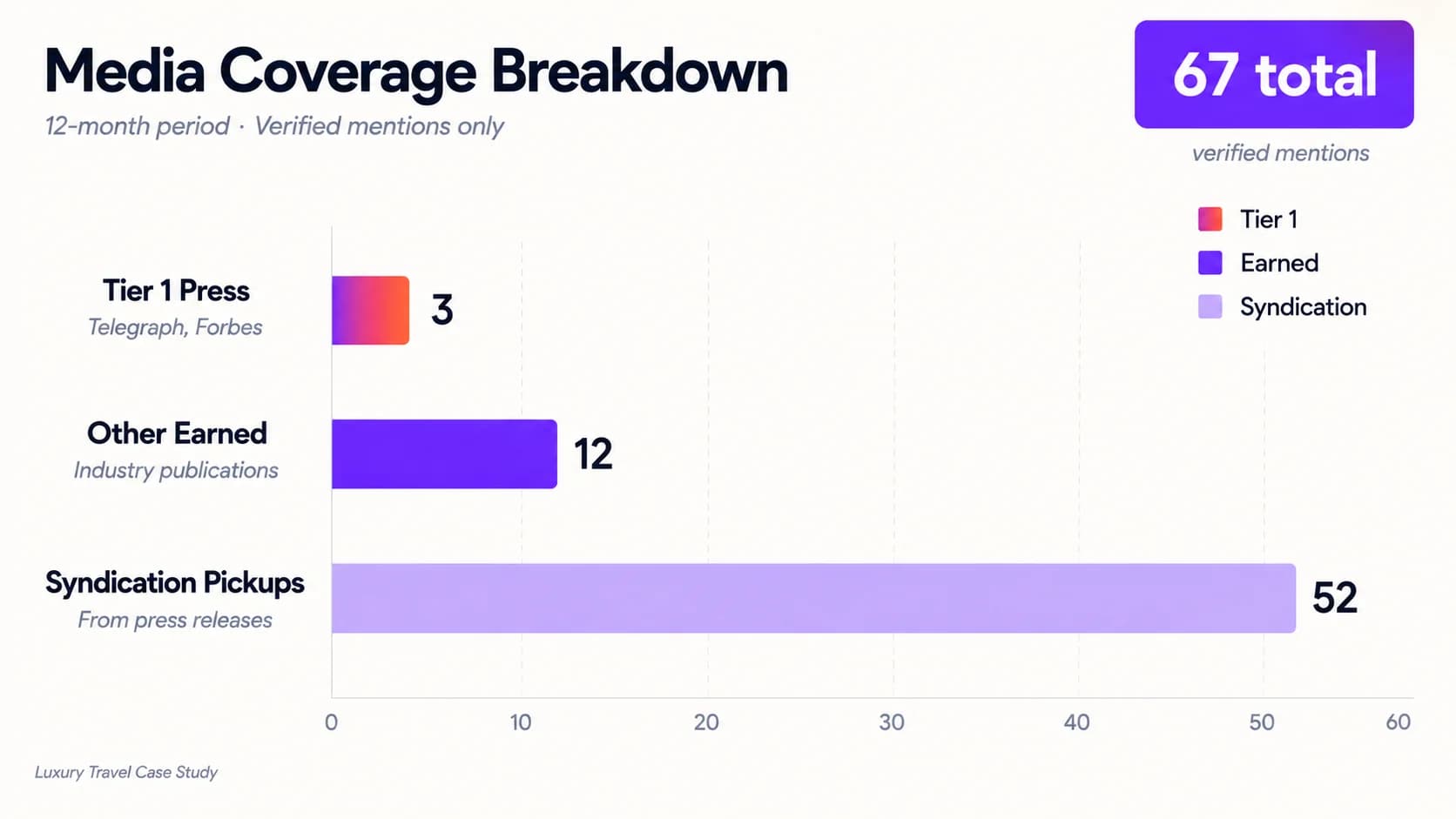
Earned media. In twelve months the brand collected fifteen verified press mentions, with two Tier 1 placements on The Telegraph and one on Forbes. This coverage was turned into an SEO signal with a dedicated press page and recap articles citing the publications via blockquotes and citation properties in the schema. This should be distinguished from press release syndication pickups, which exist on a different and lesser plane.
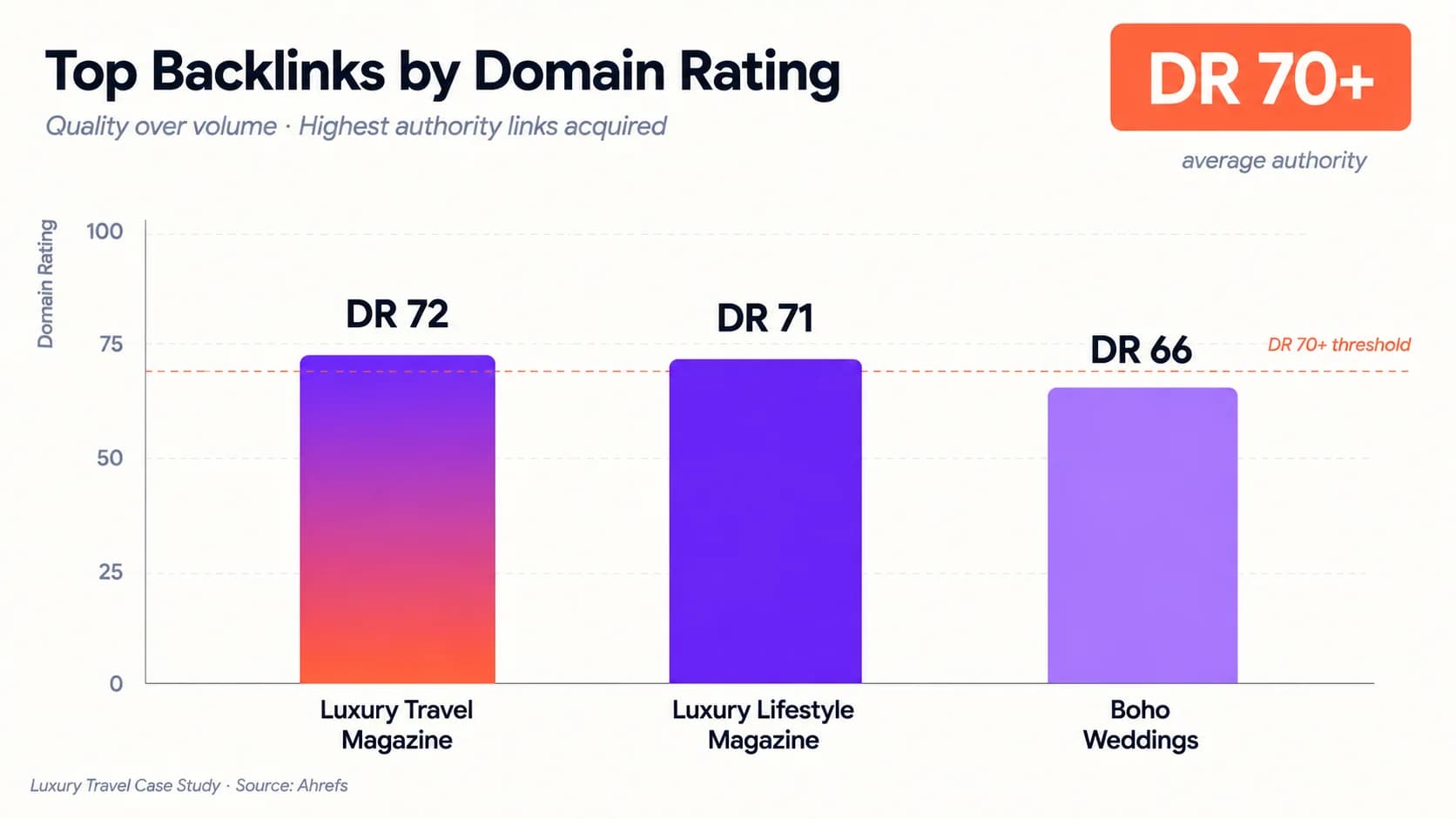
Link building. Backlink profile growth focused on quality over volume, with links from high-Domain-Rating industry publications.
Results in numbers
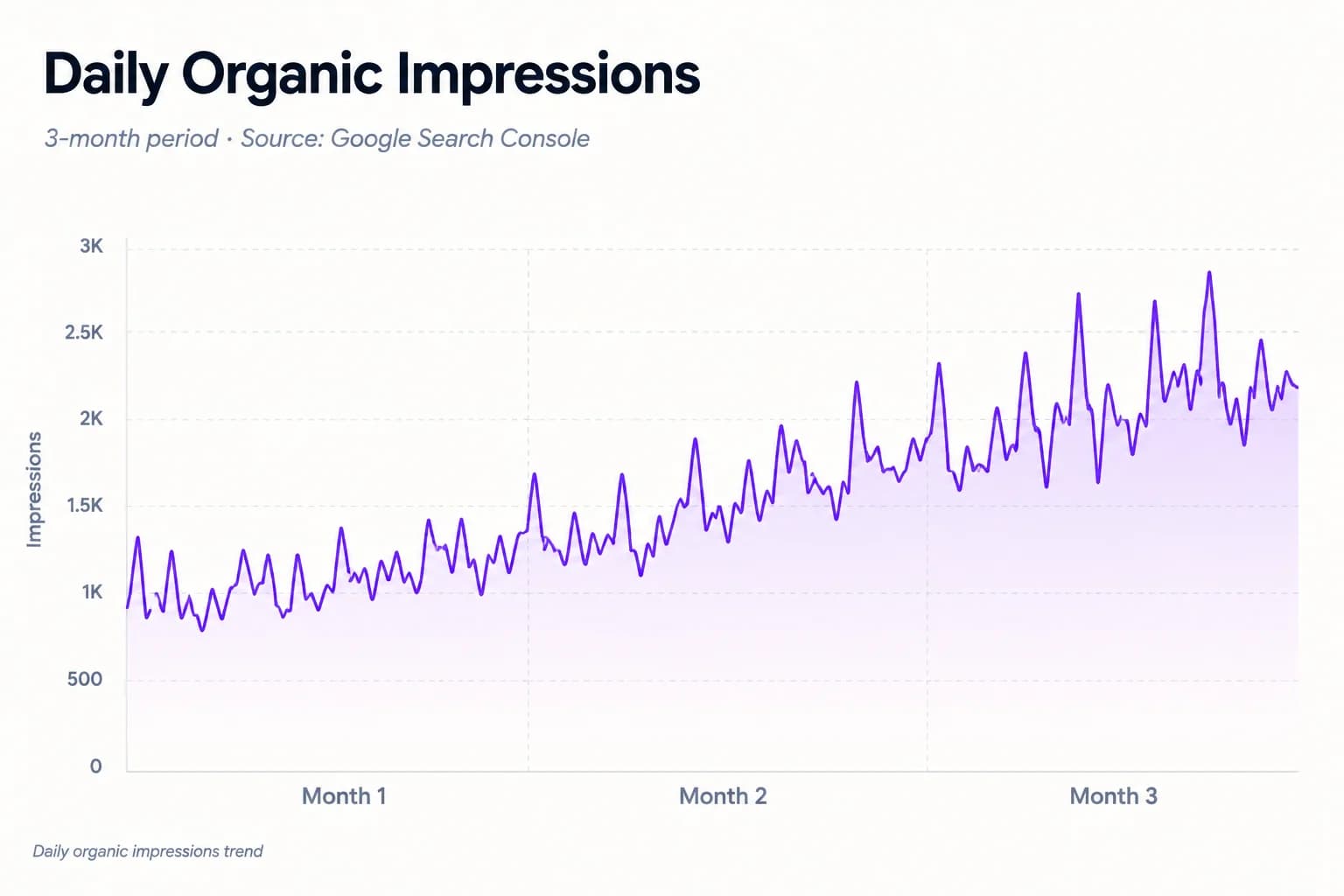
Visibility growth was steady. But the data point that changes the conversation with a client isn't average position: it's quote requests arriving directly from AI engines across four months.
| Metric | Result |
|---|---|
| Daily organic impressions | Doubled in 3 months (from ~1,300 to ~2,500, +92%) |
| Top commercial keyword | Absolute first position on "leadership retreats italy" |
| Corporate retreats hub | Around 9th position, building toward page one |
| High-potential page | "Italy honeymoon cost": 23,880 impressions, CTR to optimize |
| Flagship villa page | 43 clicks at 12% CTR |
| Leads from AI engines | 6 confirmed in 4 months (ChatGPT 3, Gemini 2, Claude.ai 1) |
| Highest-value lead | Over $57,000 (14 days, $2,050 per person per day, wedding anniversary) |
| Total AI pipeline (declared budgets) | Over $209,000 in combined declared budget from the 6 AI leads |
| Press coverage | 15 verified mentions in 12 months, including 3 Tier 1 |
The six leads from AI engines
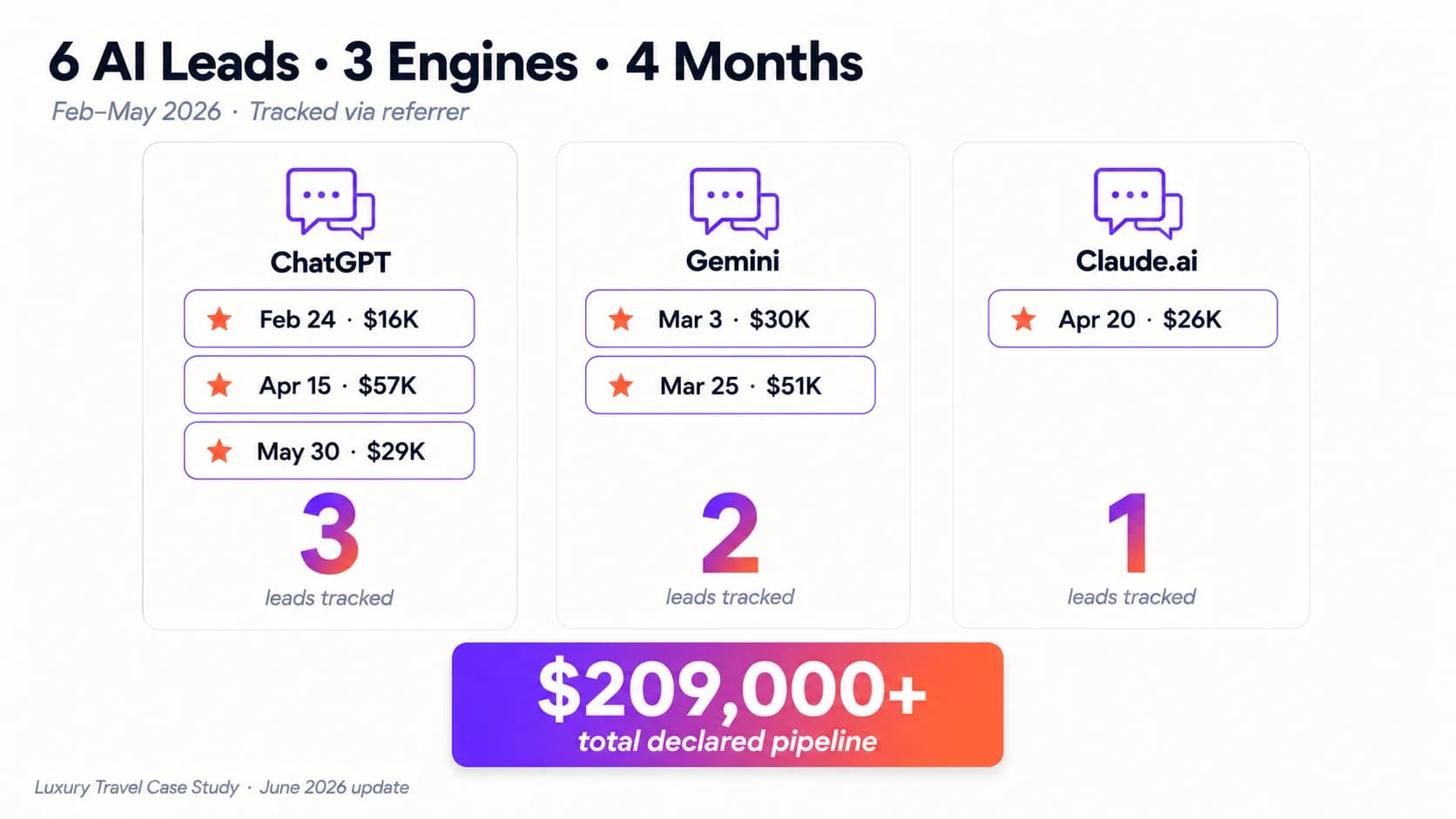
Referrer tracking showed the full path of each user. The story it tells is precise: those arriving from AI are already qualified, know the brand, have read a recommendation, and in most cases fill out the form quickly — a signal of high intent.
For privacy reasons I've anonymized the leads. The data is verifiable in the client's form provider.
| Lead | Date | AI Engine | Trip type | Estimated value (USD) |
|---|---|---|---|---|
| Lead 1 | Feb 24, 2026 | ChatGPT | Friends trip, Florence, 10 days, 2 adults | ~$16,000 |
| Lead 2 | Mar 3, 2026 | Gemini | Husband's 50th birthday, Puglia luxury, 10 days, 2 adults | ~$30,000 |
| Lead 3 | Mar 25, 2026 | Gemini | Honeymoon Ischia–Amalfi, 30 days, 2 adults | ~$51,000 |
| Lead 4 | Apr 15, 2026 | ChatGPT | Wedding anniversary, Tuscany/Amalfi/Rome, 14 days, 2 adults | ~$57,400 |
| Lead 5 | Apr 20, 2026 | Claude.ai | Anniversary, Tuscany/Puglia/Florence, 10 days, 2 adults | ~$26,000 |
| Lead 6 | May 30, 2026 | ChatGPT | Couple trip, Tuscany/Amalfi/Venice/Florence, 12 days, 2 adults | ~$28,800 |
Patterns observed across all six leads:
- High intent: nearly all filled out the quote request form within minutes of the initial click. These aren't curious clickers — they're prospects who've already decided to request a quote.
- Mid-to-high budgets: average declared budget around $35,000 per trip (range $16K–57K). AI-sourced leads for this luxury brand are in the high tier of the segment.
- Three different AI engines: the fact that leads are distributed across ChatGPT, Gemini, and Claude.ai confirms that AEO work produces a cross-engine effect — it's not a single algorithmic accident.
- Distribution over 4 months: leads aren't concentrated in a single period. There's continuity — a signal that the system built is producing recurring returns, not an isolated spike.
- Entry clusters: 3 leads from the anniversary/milestone cluster, 2 from honeymoon, 1 from friends/family. Vertical specialization by trip occasion proved effective.
These aren't anonymous clicks. They're people who asked an AI to recommend a trip to Italy, received the client's brand as the answer, and arrived ready to talk. That's exactly the goal the system was designed for.
What I take away from this project
- In luxury travel, AI engine citability is now a real acquisition channel, not a future bet. Six leads in four months on a boutique brand is not an isolated case.
- The three major AI engines (ChatGPT, Gemini, Claude) produce qualified leads if the site is built around AEO pillars. You don't need to be "Google's #1 result" — you need to be citable.
- Content wins when it answers the question immediately, brings specific data, and demonstrates direct experience. Vagueness and generic claims don't get cited.
- Technical structure matters as much as text: without schema and crawler access, even the best content stays invisible to AI.
- External authority — earned media and quality backlinks — is the trust threshold that unlocks citation.
- Publishing and iterating beats searching for perfection. Every week out of the market is rankings and leads lost.
How this know-how became CiteProof.co
Six months of custom work on a single luxury client generated 6 tracked AI leads for over $209,000 in declared total budget. Great for that client. But the model has a scaling problem: work like this costs $1,500–5,000 per month in consulting, and that's simply out of scale for most small and medium businesses. A dentist in Brooklyn, a law firm in Austin, a boutique hotel in California can't afford six months of consulting for a channel that today is still a small share of their revenue — but that by 2027 could mean far more.
Yet the problem is here now. Studies show that 78% of B2B buyers consult AI before reaching out to a vendor. And when they do, AI answers with 2–3 names, not 10 links. If you're not in those 2–3, for those customers you don't exist — even if your Google SEO is perfect.
I built CiteProof.co to answer exactly this market fracture. It's the SaaS I created by codifying an automatable part of the work you just read about:
- Monitors your visibility across ChatGPT, Perplexity, Gemini, Claude, and Google AI Overview every week, using realistic questions your actual customers would ask.
- Automatic technical audit of schema markup, AI crawler access, broken links — the three checks I showed in the case study's technical section, automated in 15 seconds via our free tools.
- Content Agent that applies AEO pillars (answer capsules, question-format H2s, FAQ schema, specific data) to your site without you having to commission content manually.
- Verify Bot that certifies each fix as "applied and readable by AI engines" before raising your score. No unverified promises.
It doesn't replace custom work. It democratizes it. For that boutique hotel that can't spend $4,500/month but can invest $19/month in an AI agent watching its citability, it's the difference between being visible and not. For that dentist, same.
CiteProof starts at $19/month for the first agent, with a free scan (no signup) for anyone who wants to see whether the problem exists for them in the first place.
Free CiteProof scanExplore the product →
Want AI engines to recommend your brand?
If you're a luxury travel or hospitality brand with budget for a 4–6 month custom engagement, we can work directly on your project. If you're an SMB looking to monitor your AI visibility without dedicated consulting, CiteProof is the right path.
Either way: hello@citeproof.co
CiteProof tracks your brand's visibility across AI answer engines and tells you what to change to get cited. With one rule: the score only moves up after the Verify Bot confirms the fix is actually live.