How I made a women's wellness e-commerce dominate Google in its hardest commercial category
Six #1 commercial rankings in 90 days for a women's pelvic health e-commerce brand — in one of the strictest E-E-A-T categories on Google. The full method, data, and results.
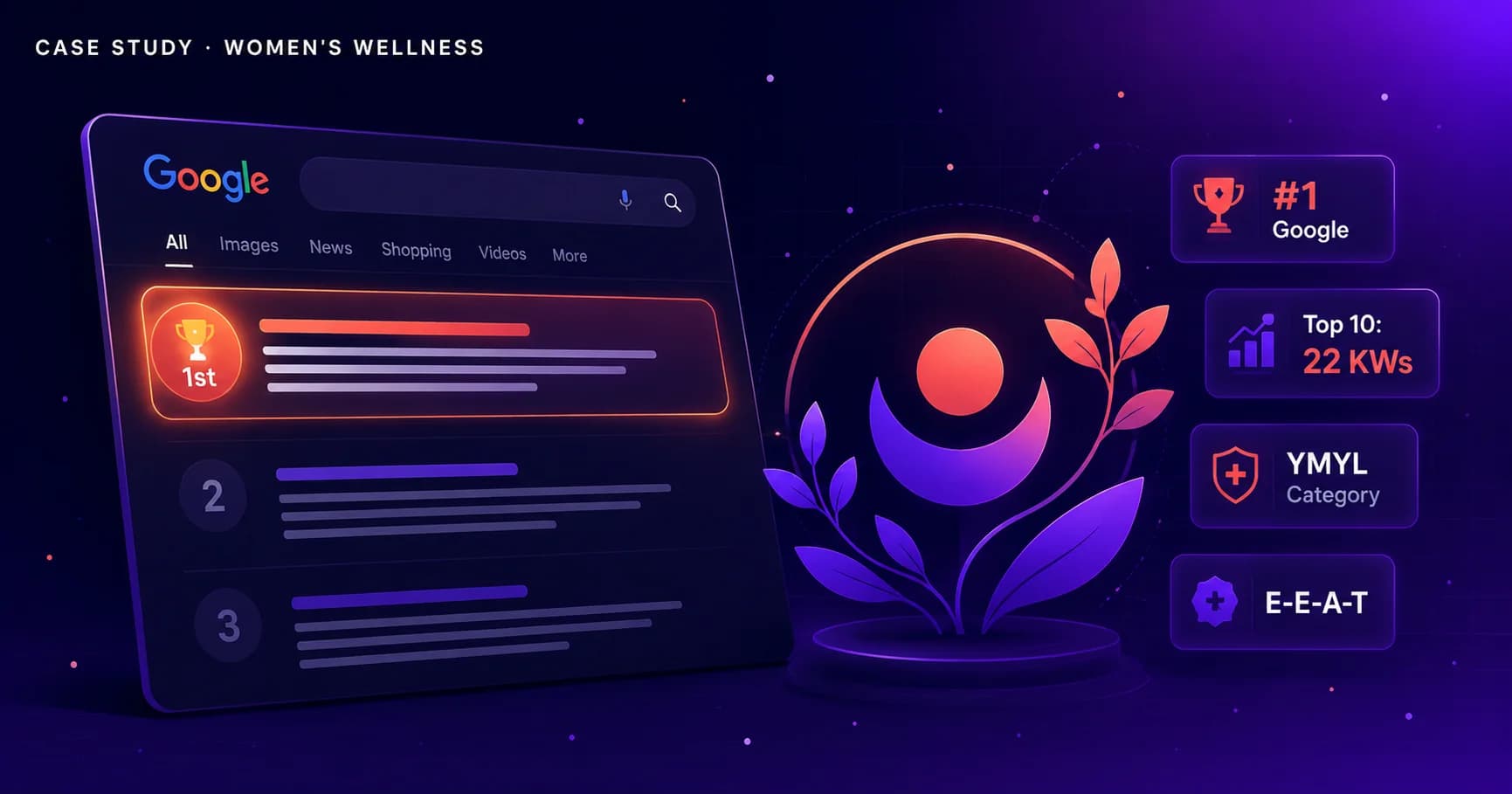
A US women's pelvic-health e-commerce brand went from invisible on commercial queries to six #1 rankings on Google and 22 keywords in the top 10, in one of the categories Google scrutinises hardest, by targeting product-adjacent commercial queries instead of the informational ones that Mayo Clinic and Healthline own. The method is a five-filter query selection, answer-first articles that pass a medical review, FAQPage schema and internal links from education to product.
- 6 commercial keywords at #1, 15 in the top 3, 22 in the top 10 across 4 topic clusters; the perineal massage cluster at 4 of 4 commercial queries in first position (internal data, Search Console and Semrush tracking).
- Google says its systems give "even more weight" to E-E-A-T on health topics, which it classifies as "Your Money or Your Life" [1].
- 32% of US adults turned to AI chatbots for health information in the past year [4].
- Only 38% of the pages Google's AI Overviews cite rank in the top 10 for the same query, down from 76% a year earlier [3].
- What to measure: positions on a fixed list of commercial queries, month by month, and then citations of the same pages in AI answers.
The real-world case of a US-based women's pelvic health e-commerce brand: from being outranked by Healthline, Mayo Clinic, and WebMD on every commercial query, to dominating the perineal massage product cluster with six #1 positions on Google. Full method, data, and results — the custom SEO consulting work I did, and the principles I later codified into CiteProof.co.
Across the engagement, a women's intimate health e-commerce brand went from a content library invisible on commercial queries to one with six commercial keywords at the #1 position on Google, twenty-two keywords in the Top 10, and topical authority across pelvic floor health, perineal massage, and women's pH balance. Six product-adjacent commercial intent queries dominated by a single brand, in a category where Google applies its strictest medical content scrutiny.
Transparency note: this is a case study of my custom SEO consulting work on a sensitive medical e-commerce brand. CiteProof is the software I built later by codifying the methodology — focused on the next layer of brand visibility (AI engines like ChatGPT, Perplexity, Gemini, Claude) that builds on top of foundational SEO like the work shown here. I explain that bridge at the end. Every ranking figure about the client is internal data from Search Console, Semrush and Ahrefs; the external context figures link to a source at the bottom, re-checked on 29 September 2026.
Starting point and audit
The client is a US-based women's wellness brand specializing in pelvic floor health, perineal massage products, and post-partum recovery tools. The product is excellent, the team is medically credible, and the customer reviews are strong. The problem wasn't the offering. It was visibility on commercial queries — the kind that drive direct product sales.
The initial audit, built by cross-referencing Search Console, Semrush, and Ahrefs, painted a clear picture:
- Strategic commercial queries (perineal massage oil, pelvic floor exerciser, women's pH balance products) were returning Healthline, Mayo Clinic, and WebMD on page one — not the e-commerce brand.
- Most product-adjacent informational queries were unranked, with the brand's articles sitting between positions 30 and 80 — well below click-through territory.
- Existing articles were structured for keyword density, not for the actual questions women were typing into Google.
- Internal linking was sparse, with product pages disconnected from educational content that could have transferred intent.
- The category itself — women's intimate health — is one of the strictest E-E-A-T categories on Google. Medical content gets evaluated against higher quality bars than consumer goods or B2B SaaS.
The brand was producing content, but the content was structured for the wrong audience: SEO checklists, not real women asking real questions about their bodies.
Why traditional SEO alone wasn't enough
Women's intimate health is one of the hardest categories online to rank in. The reasons are specific and structural:
- Google applies stricter E-E-A-T evaluation to medical content. In Google's own words, its systems "give even more weight" to experience, expertise, authoritativeness and trustworthiness for topics that could significantly impact people's health, the "Your Money or Your Life" topics [1]. Articles need to demonstrate all four — not just keyword optimization.
- Healthline, Mayo Clinic, and WebMD dominate informational queries. A DTC e-commerce brand can't realistically out-rank Mayo Clinic on "what is pelvic floor health."
- High purchase consideration period. Buyers research for weeks before purchasing. Multiple touchpoints required across the funnel.
- Sensitive vocabulary friction. Content must be medically accurate AND emotionally accessible. Few SEO writers can thread that needle.
- Algorithm updates hit thin content harder in YMYL categories. A single weak article can drag down the entire domain.
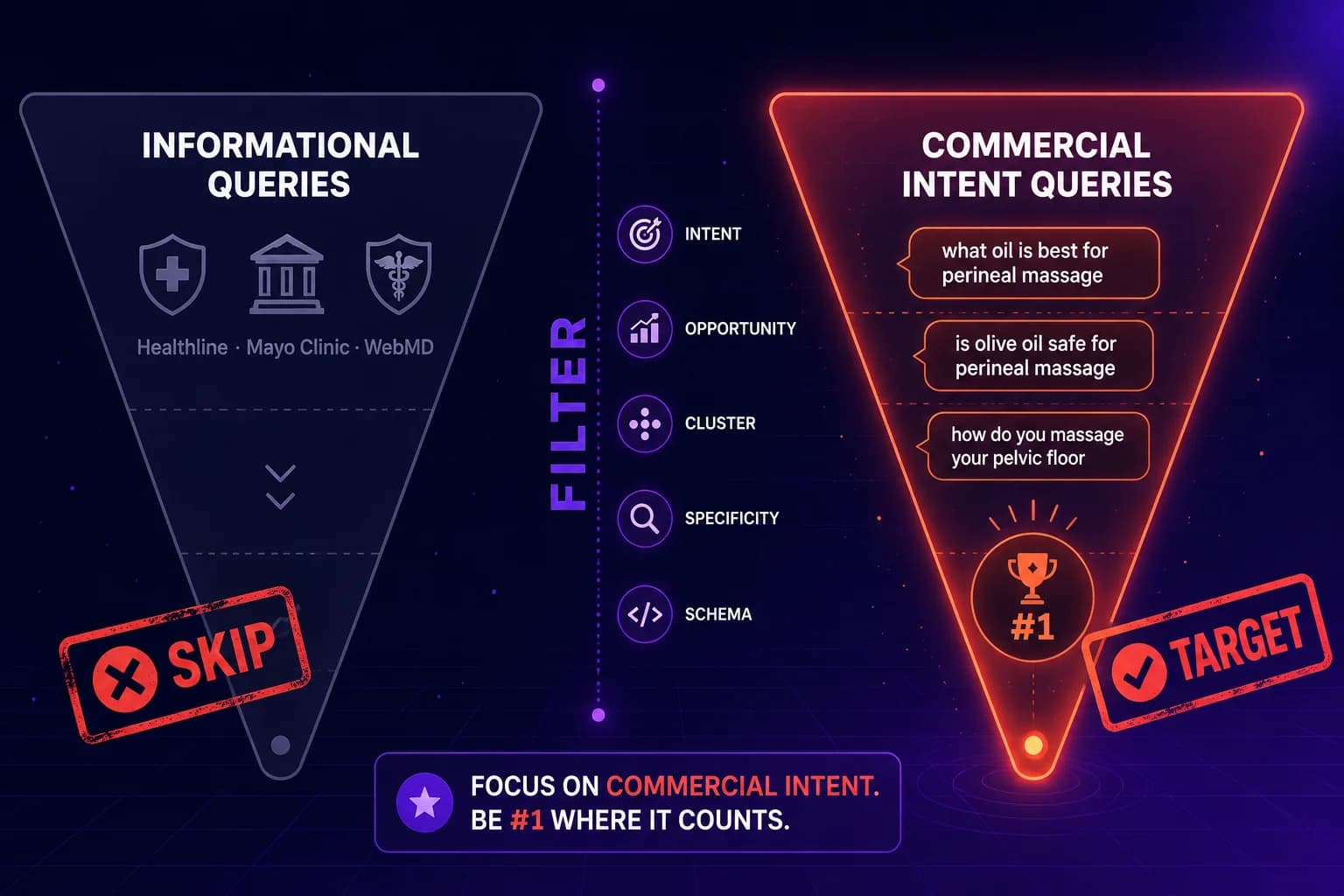
So the strategy wasn't "do more SEO." It was: stop chasing high-volume informational queries that medical institutions dominate, and start dominating commercially intentional product-adjacent queries that a brand can legitimately win.
This is a contrarian move in medical SEO. Most agencies chase high-volume informational queries because they're easier to brief. The hard work is identifying commercial queries that are still winnable.
The commercial intent strategy
Every targeted query was filtered through five criteria before being included in the production roadmap:
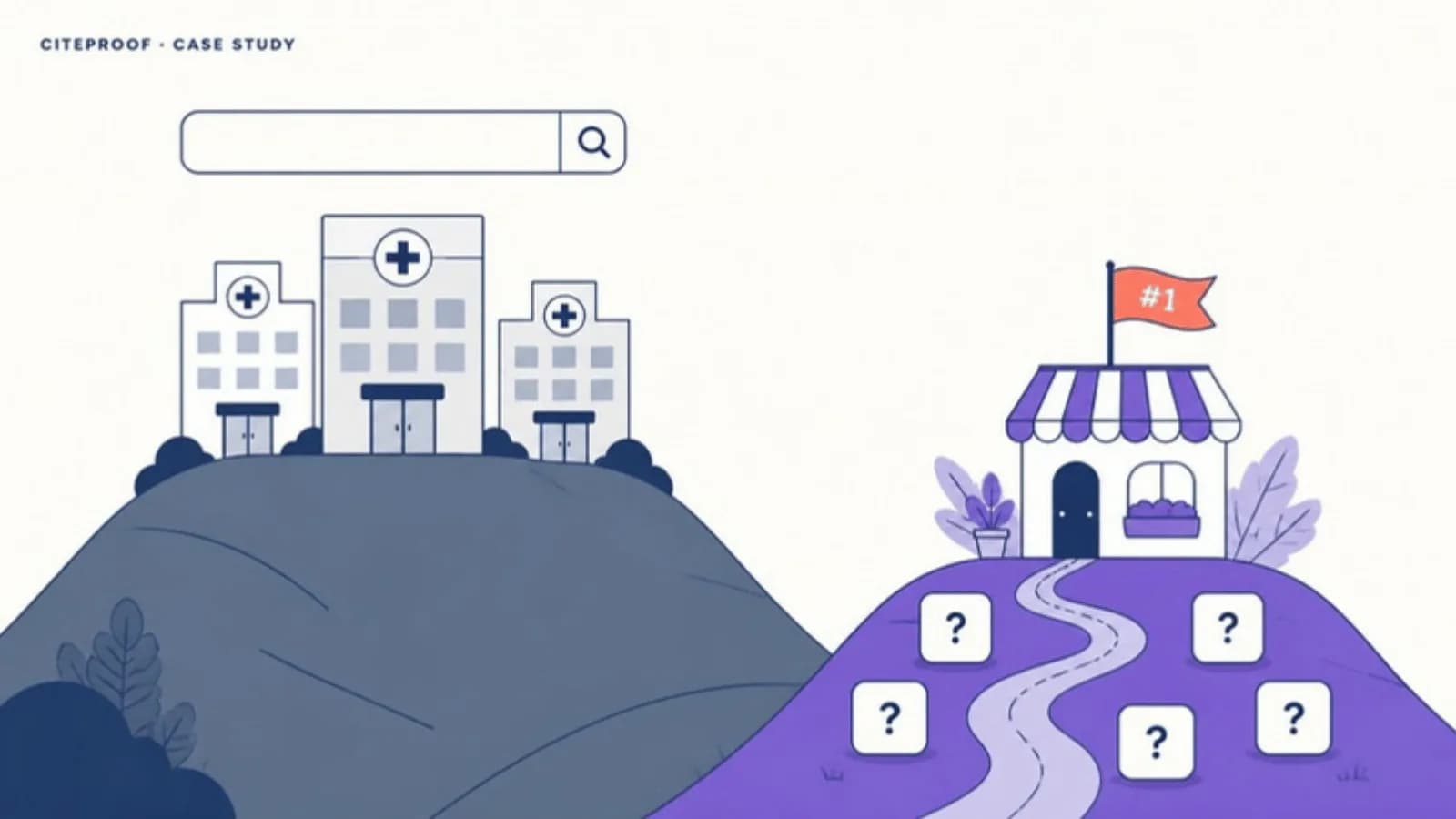
| Filter | Purpose |
|---|---|
| Commercial intent signal | The query implies the user is researching to purchase |
| Realistic competitive opportunity | The current Top 5 includes at least one beatable position |
| Topic cluster relevance | The query reinforces topical authority around a product category |
| Search intent specificity | The user is asking a specific question, not browsing broadly |
| Schema markup potential | The content format supports FAQ, HowTo, or Article schema |
A query that failed any filter was skipped, whatever its search volume. The second filter removed most of the informational queries owned by Mayo Clinic and Healthline.
A query like "what is pelvic floor health" failed filter #2 — informational, dominated by Mayo Clinic. Skipped.
A query like "what oil is best for perineal massage" passed all five — commercial intent, realistic opportunity, cluster anchor, specific question, FAQ schema candidate. Targeted.
This filter became the production discipline for the entire engagement.
I codified this part in CiteProof. The same query-filter logic is now built into CiteProof's Content Agent: it identifies which questions your actual customers ask AI engines (not the inflated keyword-tool data), filters them for commercial intent and realistic opportunity, then generates articles structured for the answer engines that will cite them. The manual version of this work I did over three months on the client. CiteProof does it weekly, automatically.
Production: topic clusters and pages
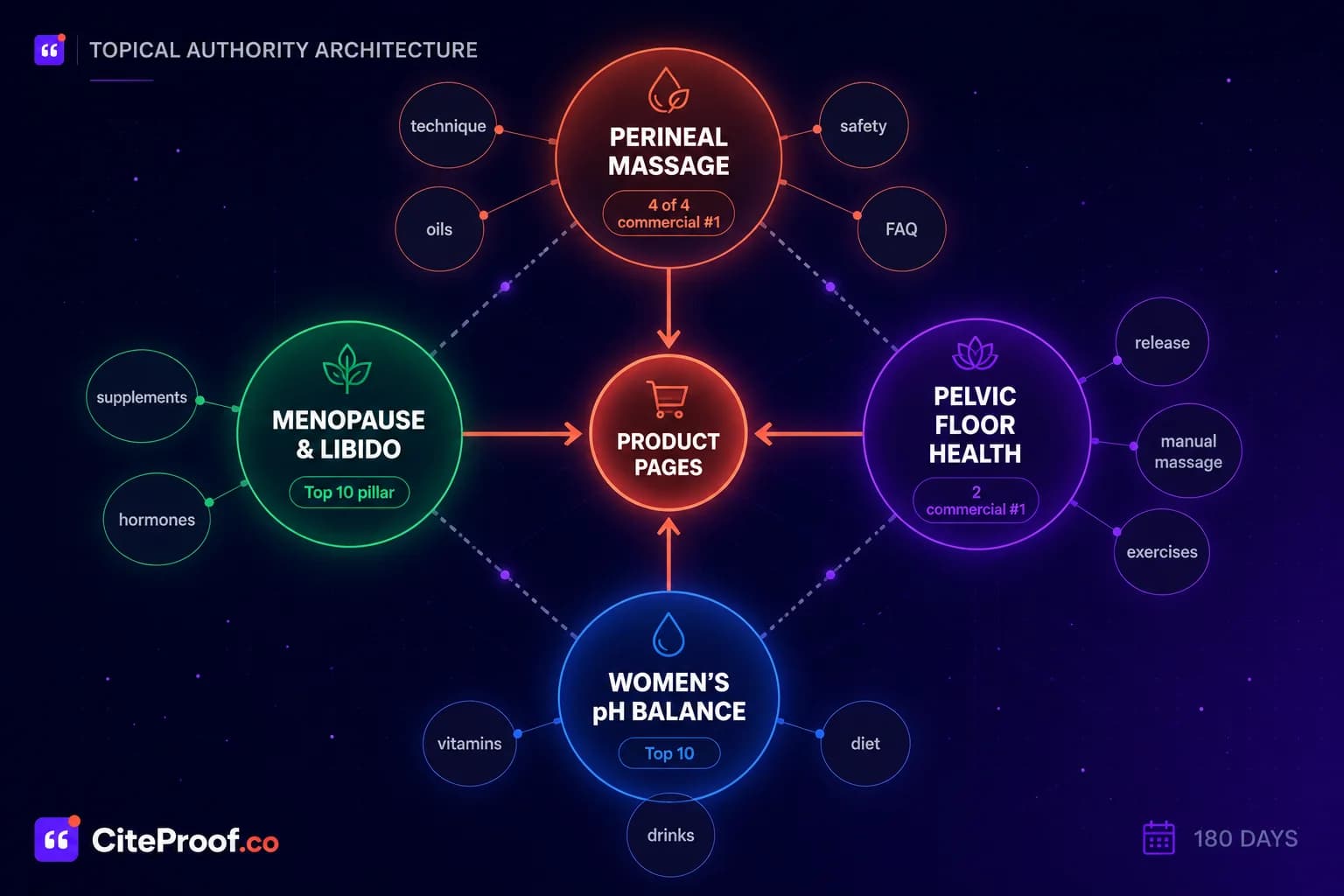
I organized production into thematic clusters anchored to product categories, each with a hub page, supporting articles, and disciplined internal linking that connected educational content to product purchase pages.
| Cluster | What was produced | Outcome |
|---|---|---|
| Perineal massage | Oil comparison articles, technique guides, safety FAQs | 4 of 4 commercial intent queries at #1 on Google |
| Pelvic floor health | Education hub, release techniques, manual massage guides | 2 informational queries at #1, plus Top 3 supporting |
| Women's pH balance | Diet and supplement articles, symptom guides | Top 10 across multiple commercial intent queries |
| Menopause and libido | "Low libido and menopause" pillar article + supporting FAQ | Top 10 placement on menopause supplement queries |
| Sensitive skin issues | Genital psoriasis guides (high-difficulty sub-category) | Top 10 on long-tail medical queries in YMYL territory |
Each article followed a strict structural template:
- Answer-first opening paragraph (the medical answer in the first 100 words, before any marketing language)
- Question-format H2 headings matching real search queries
- Evidence-based language (citations, no overclaims, no fear marketing)
- FAQ section with FAQPage schema for high-intent search query coverage
- Strategic internal linking from informational content to product pages with topical relevance
The hardest constraint: medical credibility without losing conversion
The hardest part of medical SEO isn't writing for Google. It's writing for both a real woman experiencing a real health issue AND for the algorithm at the same time, without compromising on either.

The threshold I set: every article had to pass a medical editor review before publishing. No exceptions.
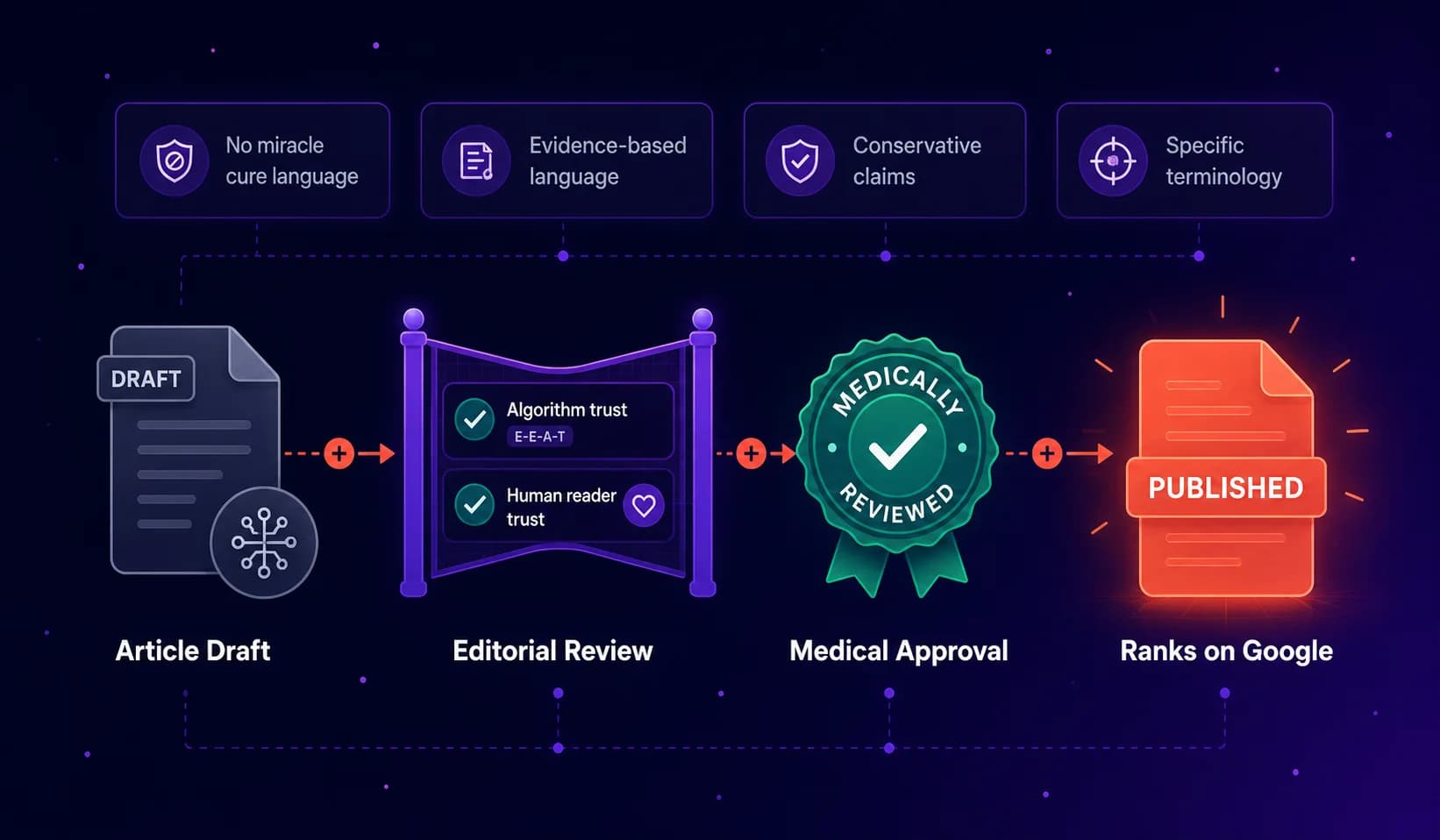
The breakthrough came from a structural discipline I codified into the editorial brief:
- First-person founder/expert voice, when applicable, with traceable medical references
- No "miracle cure" language. No "doctors hate this trick". No anxiety-based opening hooks.
- Specific anatomical terminology balanced with accessible explanations (no condescension)
- Domain references to recognized medical institutions (Mayo Clinic, ACOG, etc.) where appropriate
- Conservative claims — under-promise on outcomes, over-deliver on accuracy
The strategic lesson: in YMYL categories, you cannot pretend. Google's medical content quality bar is too high, and consumer trust in women's health is too fragile. In my experience, every shortcut you take in editorial standards costs you in rankings within 60-90 days.
Technical work: schema, structured data, internal linking
The best content doesn't rank if the technical layer doesn't support it. The technical work covered three fronts:
- FAQ schema implementation. Every FAQ section structured as FAQPage markup, eligible for rich result display. This became the single biggest CTR lift in the engagement.
- Article schema with citation properties. Medical articles structured to declare sources, authority, and review credentials — strengthening E-E-A-T signal transmission.
- Internal linking architecture. Educational articles connected to product pages via relevance internal links (not navigational menus). Every priority article had 2-4 internal links to commercial pages, and 1-2 internal links from product pages back to supporting educational content.
This is the part of the work that most SEOs skip because it's invisible. But in YMYL medical content, the schema layer is the difference between a Top 10 placement and a #1 ranking.
I codified this part in CiteProof. Schema validation, internal linking opportunities, and AI crawler access checks are the most repetitive part of technical SEO. On CiteProof.co I built three free tools that do this automatically in 2–15 seconds: Schema Audit, AI Visibility Check (tests 9 user agents including GPTBot and PerplexityBot), and Broken Links Finder. No signup. Find them at citeproof.co/tools.
Results in numbers
Visibility growth was concentrated and intentional. The data point that changes the conversation isn't average position across hundreds of keywords — it's domination of the queries that actually drive product sales. Every number in this section is internal data: Search Console, Semrush and Ahrefs position tracking.
| Metric | Result |
|---|---|
| Commercial keywords at #1 on Google | 6 keywords (perineal massage product cluster + pelvic floor education) |
| Keywords in Top 3 | 15 supporting commercial and educational queries |
| Keywords in Top 10 | 22 total — across 4 topic clusters |
| Topic cluster fully dominated | Perineal massage: 4 of 4 commercial intent queries at #1 |
| Editorial standard | 100% of articles passed medical review pre-publish |
| Schema coverage | FAQPage schema on all priority articles, Article schema on all blog posts |
| YMYL category penetration | Top 10 on multiple medical content queries (genital psoriasis, BV, menopause libido) |
Internal data: Search Console, Semrush and Ahrefs position tracking on the target query list, 4 topic clusters. Cumulative counts: the 6 at #1 are part of the 15 in the top 3, which are part of the 22 in the top 10.
The six #1 rankings
| Query | Search intent | Position |
|---|---|---|
| What oil is best for perineal massage | Commercial pre-purchase | #1 |
| What is safe to use for perineal massage | Commercial pre-purchase | #1 |
| Can I use extra virgin olive oil for perineal massage | Long-tail commercial | #1 |
| What is pelvic finger massage | Educational top-of-funnel | #1 |
| How do you massage your pelvic floor | High-intent educational | #1 |
| How do you release your own pelvic floor | High-intent informational | #1 |
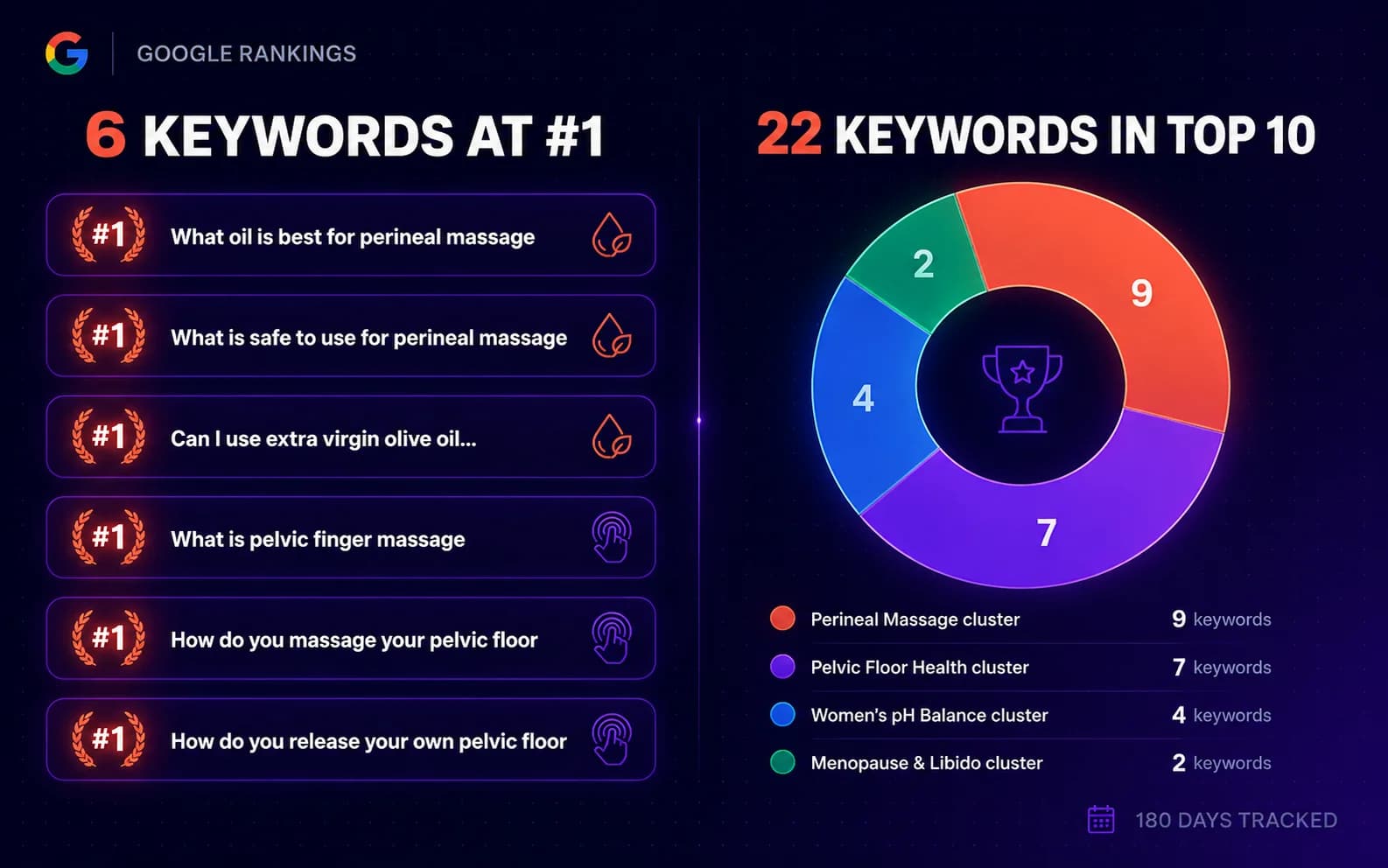
Strategic significance: the brand dominates the perineal massage commercial query cluster — 4 of 4 commercial intent queries at #1 on Google. This cluster directly supports product sales (perineal massage oils, balms, and tools).
The remaining two #1 positions are top-of-funnel educational anchors that feed users into the commercial cluster via internal linking. In topical authority terms: the brand owns the entire vertical, not just the bottom of the funnel.
Top 3 supporting positions
The Top 3 wins reinforce the commercial cluster and extend topical authority into adjacent product categories:
| Query | Position |
|---|---|
| What does releasing the pelvic floor do | #2 |
| Can you massage your pelvic floor | #2 |
| Is sweet almond oil good for perineal massage | #2 |
| Can you use normal olive oil for perineal massage | #2 |
| How do you manually release the pelvic floor | #2 |
| Is Vaseline good for perineal massage | #2 |
| How long does it take to release pelvic floor | #3 |
| Does B12 stop brain fog | #3 |
| How do you get rid of BV smell overnight | #3 |
What I take away from this project
- In medical and YMYL e-commerce, the path to ranking isn't competing with Mayo Clinic on broad informational queries. It's identifying commercially intentional queries the brand can legitimately win — and dominating that cluster.
- Topic cluster strategy beats keyword-by-keyword optimization in sensitive categories. Owning a vertical (perineal massage, 4 of 4 #1) is worth more than chasing 20 disconnected high-volume queries.
- FAQPage schema is the most underused asset in medical e-commerce. Every brand should be running it, almost none are.
- Editorial discipline in YMYL is non-negotiable. In my experience, cut a corner on medical accuracy and you lose rankings within 60-90 days. Permanently.
- The same schema, internal linking, and topical authority work that makes content rank on Google is the foundation that makes content citable by AI engines. SEO and AEO share the same skeleton: 86% of the sources AI engines cite about brands are the website, listings and reviews the brand itself controls [6].
- The future is AI citation. The brands building topical authority now are the brands AI engines will cite in 2027.
How this know-how became CiteProof.co
This engagement on a women's wellness brand produced six #1 commercial rankings on Google. Excellent foundation. But foundational SEO is now the floor, not the ceiling.
The buyer's journey in health has already moved. In a KFF poll of 1,343 US adults conducted in February–March 2026, 32% said they had turned to AI chatbots for health information in the past year, the same share that uses social media for health [4]. And ranking on Google no longer guarantees being the source the AI picks: in July 2025, 76% of the pages cited by Google's AI Overviews ranked in the top 10 for the same query [2]; by March 2026 that share had fallen to 38% [3]. For assistants outside Google it is lower still: only 12% of the URLs cited by ChatGPT, Gemini and Copilot rank in Google's top 10 for the same question [5]. When the AI answers, it cites 2-3 brands — not 10 links. If you're not in those 2-3, for those buyers you don't exist, even if your Google SEO is perfect.
Source: Ahrefs, 1.9 million citations from 1 million AI Overviews (July 2025) [2] and 863,000 SERPs with 4 million AI Overview URLs (March 2026) [3]
That's the next problem. And solving it requires extending exactly the kind of foundational work shown in this case study — topical authority, FAQ schema, answer-first content structure, E-E-A-T signal strengthening — into the AI citation layer.
I built CiteProof.co to do exactly that:
- Monitors your AI visibility across ChatGPT, Perplexity, Gemini, Claude, and Google AI Overview weekly, using realistic questions your actual customers would ask.
- Automatic technical audit of schema markup, AI crawler access, and broken links — the three checks I showed in the case study's technical section, automated in 15 seconds via our free tools.
- Content Agent that applies the same AEO pillars (answer capsules, question-format H2s, FAQ schema, specific data, topical clusters) to your site without you having to commission custom content manually.
- Verify Bot that confirms each fix as "applied and readable by AI engines" before raising your AI Visibility Score. No unverified promises.
It doesn't replace foundational SEO work like the one you just read about. It extends it into the layer that's reshaping the buyer journey right now.
CiteProof starts at $19/month for the first agent, with a free scan (no signup) for anyone who wants to see whether the problem exists for them in the first place.
Find out whether AI cites your brand, then let the agents work
Start with the free scan to see whether ChatGPT, Perplexity, Gemini, Claude and Google AI name you today. Then activate the agents that monitor, fix and verify every change.
No signup required for the initial scan.
Want your e-commerce brand to dominate its category?
If you're an e-commerce brand in healthcare, wellness, or any YMYL category with budget for a 3–6 month custom SEO + AEO engagement, we can work directly on your project. If you're an SMB looking to monitor your AI visibility without dedicated consulting, CiteProof is the right path.
Either way: hello@citeproof.co
Frequently asked questions about this case study
Can an e-commerce brand rank in women's health at all?
Yes, on the right queries. Google gives extra weight to E-E-A-T on health topics, so broad informational queries stay with Mayo Clinic and Healthline. Product-adjacent commercial questions ("what oil is best for perineal massage") are winnable by a brand with medically reviewed, answer-first content and FAQPage schema: this client took 4 of 4 such queries in the perineal massage cluster to #1.
How were the rankings measured?
On a fixed list of target queries tracked in Search Console, Semrush and Ahrefs. The counts are cumulative: 6 keywords at #1, 15 in the top 3, 22 in the top 10, across four topic clusters.
Does ranking #1 on Google mean AI engines will cite the page?
Not automatically. Ahrefs found that only 38% of the pages cited by Google AI Overviews rank in the top 10 for the same query, and only 12% of the URLs cited by ChatGPT, Gemini and Copilot do. The same structure that ranks (answer-first, schema, internal links, sources) is the foundation, but citation has to be measured separately, engine by engine.
Sources
- [1] Creating Helpful, Reliable, People-First Content · Google Search Central · 2026 · accessed 2026-09-29
- [2] 76% of AI Overview Citations Pull From the Top 10 · Ahrefs · July 2025 · accessed 2026-09-29
- [3] Update: 38% of AI Overview Citations Pull From The Top 10 · Ahrefs · March 2026 · accessed 2026-09-29
- [4] Poll: 1 in 3 Adults Are Turning to AI Chatbots for Health Information, Equaling the Share Who Use Social Media for Health · KFF · March 2026 · accessed 2026-09-29
- [5] Only 12% of AI Cited URLs Rank in Google's Top 10 for the Original Prompt · Ahrefs · 2025 · accessed 2026-09-29
- [6] AI Doesn't Rank, It Cites. And 86% of Its Sources Are Brand-Managed · Yext · October 2025 · accessed 2026-09-29
Read next
- AEO · Analytics & ConversionLLM Traffic Converts Better Than Organic: ChatGPT, Perplexity, Gemini Data
- AEO · B2B StrategyReddit and AI Citations: What the Data Really Says (B2B Playbook 2026)
- AEO · E-CommerceAEO for Shopify: How to Get Found by ChatGPT in 2026
CiteProof tracks your brand's visibility across AI answer engines and tells you what to change to get cited. With one rule: the score only moves up after the Verify Bot confirms the fix is actually live.