Does ChatGPT Recommend Local Businesses? How It Picks Them
Yes: ChatGPT names local businesses, mostly from directories, reviews and their own sites. What the studies found and what an owner can do.
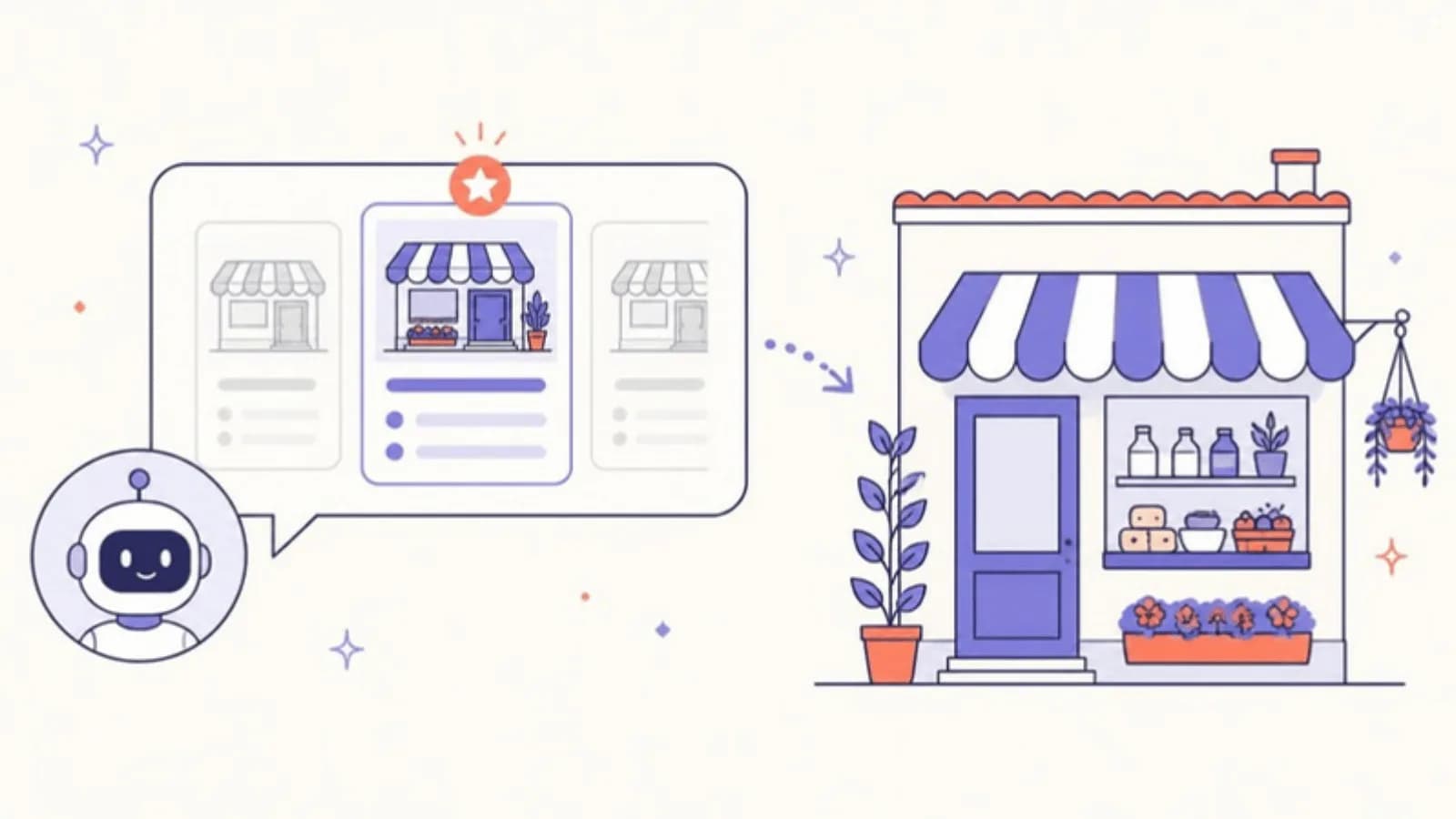
Yes. Ask ChatGPT for a dentist, a plumber or a restaurant in a city and it answers with a short list of named businesses, often with the sources it used. It picks them from what it can read: directories and review platforms first, then the businesses' own websites. In a 2026 study of 1,355 business locations, Yelp was a source in 80% of ChatGPT's local answers, while Google's own AI answers leaned on Google Business Profile [2]. You cannot pay to be on the list. You can make sure the places it reads say the right things about you.
- 45% of US consumers used ChatGPT or other AI tools for local recommendations in BrightLocal's 2026 survey, up from 6% a year earlier [1].
- Across ChatGPT and Google's AI answers, Google Business Profile made up 28.5% of all cited sources and Yelp 8.53% [2].
- Around 93% of the cited domains were individual business websites: your own site is read too [2].
- The mix changes by trade. In healthcare, listings were 52.6% of the cited sources. In food service, reviews and social media were 13.3%, the highest of any industry [3].
Want to know if AI assistants recommend your site? Free scan, about a minute →
Check your own business
When a customer asks for the best dentist in your city, the AI answers with a few names. CiteProof measures whether you are one of them and keeps location, hours and contacts aligned on your site.
A local business is one that customers visit or call in a place: a dental practice, a law office, a restaurant, a hotel, a plumber. This guide covers what the published studies say about how AI assistants choose such businesses, and what an owner can do about it.
It contains no field test of our own. A local test names real businesses, and we publish first-hand numbers only from our demo sites. Every figure below comes from a source I opened on November 20, 2026, listed at the bottom. BrightLocal and Yext, the two studies I lean on most, sell software for local marketing. I say so because it is their interest that listings matter. Their samples are large, so I use them.
Do people really ask ChatGPT for a local business?
Yes, and far more than a year ago. BrightLocal surveys US consumers every year about how they choose local businesses. In the 2026 edition, 45% said they used ChatGPT or other generative AI tools for local recommendations. The year before it was 6% [1].
Source: BrightLocal, Local Consumer Review Survey 2026, a panel of 1,002 US adults.
That makes AI tools the third most popular source of business recommendations in the survey. Google is still far ahead as a place to read reviews, but its share dipped from 83% to 71% in a year. On trust, more consumers trust AI platforms to recommend a business (40%) than do not (32%) [1].
One survey of 1,002 people is not the whole country. It does say that the question in this article's title is no longer a curiosity.
What a local answer looks like
Ask an assistant "best dentist for implants in Austin, open on Saturday" and you do not get a map with twenty pins. You get a few names, a line about each, and often the pages the answer was built from.
Two words are worth keeping apart. Your business is recommended when its name is in the answer. It is cited when the answer links to one of your pages or uses it as a source. A directory can be cited while your business is recommended: the name is yours, the source is the directory's page about you.
The assistant also takes the customer's place into account. In Yext's words, "all the major AI models consider a user's location as part of their calculus" [3].
Where the assistants find local businesses
The most detailed public study I could open is BrightLocal's, from August 2026. It ran 5 questions from 9 map points for each of 1,355 business locations in the US, the UK and Australia: 60,970 checks on ChatGPT, Google AI Overviews and Google AI Mode. It counted 1,967,762 cited sources across 116,670 websites [2].
Yext's study, from October 2025, covers 6.8 million citations from Gemini, OpenAI and Perplexity [3]. Put together, they show that each assistant has its habits.
| Assistant | What the studies observed |
|---|---|
| ChatGPT | Yelp is its most used local source: it appeared in 80% of ChatGPT's answers. TripAdvisor, OpenTable and the Better Business Bureau follow. Google Business Profile was not a top source. ChatGPT read the fewest websites of the three: 6,025 third-party domains [2]. |
| Google AI Overviews and AI Mode | Google Business Profile is "the source of choice", used "for virtually every location". Yelp comes second [2]. |
| Gemini | It "favors first-party websites", meaning the business's own site [3]. |
| Perplexity | It "diversifies across a mix of sources, including review platforms and local pages" [3]. |
Two more findings matter for a small business. Around 93% of the cited domains were individual business websites, so your own site is read, not only the big platforms. And the assistants turn to specialist sources depending on the kind of business [2].
Yext shows the same thing by trade [3]:
| Trade | What stood out |
|---|---|
| Healthcare | Listings were 52.6% of the cited sources, with health directories in front |
| Food service | Reviews and social media were 13.3%, the highest of any industry; listings were 41.6% |
| Retail | 47.6% of the cited sources were the businesses' own websites |
| Finance | 48.2% of the cited sources were brand-owned websites, such as local banking pages |
How it picks: what is published and what is not
Google publishes the rule for its local results. They are "mainly based on relevance, distance, and popularity". The same page adds: "There's no way to request or pay for a better local ranking on Google" [4]. This matters beyond Google Maps because, in the BrightLocal study, Google's AI answers lean on the Business Profile [2].
I found no page where OpenAI lists such factors for ChatGPT. What exists is what the studies observed: ChatGPT reads directories, review platforms and business websites, and it takes the customer's location into account.
From this, three questions an owner can act on:
- Are you in the right place? You cannot move your shop. You can state your address and the areas you serve clearly, and write them the same way everywhere.
- Do you do what was asked? Google calls this relevance: how well your profile matches what someone is searching for. A customer who asks for "implants" and "Saturday" needs a page or a listing that says implants and Saturday hours.
- Are you known? Google calls this prominence. It is based on things like "how many websites link to your business and how many reviews you have" [4].
What a local business can do, in order
1. Claim and complete your Google Business Profile
It is the main source for Google's AI answers in the BrightLocal study. Google's own advice: "Businesses with complete and accurate info are more likely to show up in local search results" [4]. Verify the profile. Fill in the category, the services, the hours and the special hours for holidays. Many owners have not started: BrightLocal's research, quoted in its survey, found that just 35% of small and medium businesses have a Google Business Profile [1].
2. Get listed where the assistants look for your trade
For ChatGPT, the study puts Yelp first. After that come TripAdvisor, OpenTable and the Better Business Bureau, and specialist directories that change with the trade [2]. In healthcare, Yext found health directories in front [3].
The quickest way to find your own list: ask the assistant your customer's question and read the sources under the answer. Those are the places to be listed, with correct data.
3. Make your name, address, phone and hours identical everywhere
Website, Google Business Profile, Yelp, trade directories, social profiles. An old phone number on one directory, or a trading name that differs from the name on your site, gives a machine two versions of you. Check them again every few months, and after every move or change of hours.
4. Give each service and each location its own page, in text
A page called "Our services" with a list of words answers no question. A page called "Dental implants in Austin: how long they take and what they cost" answers one. Put the answer in the first two sentences. If you have more than one location, give each its own page with its own address, phone and hours.
You can also state these facts in the page's code, in a fixed format called structured data. For a local business the format is named LocalBusiness. With it, Google says, "you can tell Google about business hours, different departments within a business" and more [6]. It prevents mistakes about your hours or address. It does not replace the text, and Google asks that it match what the page shows [5].
5. Ask for reviews, and answer them
Google says it plainly: "More reviews and positive ratings can help your business's local ranking" [4]. In food service, reviews and social media weighed more than in any other industry: 13.3% of the cited sources [3]. Ask real customers, on the platform your trade uses. Answer the good ones and the bad ones. Never buy reviews and never write them yourself.
6. Do not lock out the search crawlers
A crawler is a program that visits your pages and reads them. If your site blocks OpenAI's search crawler, OAI-SearchBot, your site is not shown in ChatGPT search answers [7]. The free AI visibility check tests 9 AI crawlers against your site in about 15 seconds.
What you cannot control
- Where the customer is. Distance is one of Google's three factors, and the assistants use location.
- Which directories an assistant reads. The lists in the studies are a picture of 2025 and 2026. They can change.
- The answer itself. Ask the same question twice and the names can differ. One answer proves little.
- What others write. Reviews are your customers' words.
- Payment. Google offers no way to pay for a better local ranking [4]. Since February 2026 ChatGPT shows ads to some users, labeled as sponsored, and OpenAI says they do not influence the answers [8].
Nothing in this guide makes a recommendation certain. It makes sure that when an assistant reads about you, it finds complete, matching facts.
How to check whether AI recommends you in your city
- Write eight questions with the place in them. "Best [your trade] in [your city]". "[Your trade] near [your neighborhood] open on Saturday". "How much does [your service] cost in [your city]".
- Ask ChatGPT, Perplexity and Gemini. Name the city in the question, so the answer does not depend on where you are sitting.
- Note the names, the sources and the date. Are you named? Who is named instead? Which directories and pages does the answer link to?
- Ask again next month. Same questions, same assistants.
To try one question quickly, the free AI citation checker sends it to ChatGPT, Perplexity and Gemini and shows who each one cites or recommends. The general method, for any kind of business, is in How to get your business recommended by ChatGPT.
Find out whether AI recommends you or a competitor
CiteProof's free scan asks ChatGPT, Perplexity and Gemini five questions your customers ask and shows whether they name you, and who shows up instead. About a minute, no sign-up.
Frequently asked questions
Does ChatGPT recommend local businesses?
Yes. For a question such as "best plumber in Denver" it answers with a short list of named businesses, often with its sources. In BrightLocal's 2026 survey, 45% of US consumers said they used ChatGPT or other AI tools for local recommendations, up from 6% the year before.
Does ChatGPT use Google Business Profile?
In BrightLocal's 2026 study it was not a top source for ChatGPT. Yelp was: it appeared as a source in 80% of ChatGPT's local answers. Google's own AI answers, AI Overviews and AI Mode, used Google Business Profile for virtually every location. Since customers use both, keep both listings complete.
Which directories matter most for ChatGPT?
In the same study: Yelp first, then TripAdvisor, OpenTable and the Better Business Bureau, with specialist directories depending on the trade. The list for your business may differ. Ask ChatGPT your customer's question and read the sources under the answer.
Can I pay to be recommended in my city?
No. Google states there is no way to request or pay for a better local ranking. ChatGPT shows ads to some users, labeled as sponsored, and OpenAI says they do not influence its answers.
Do reviews decide who gets recommended?
They are one factor, not the only one. Google says more reviews and positive ratings can help local ranking. In Yext's study, reviews and social media were 13.3% of the cited sources in food service, the highest of any industry. Across all industries the share was 8%.
Do I still need a website if my listings are complete?
Yes. Around 93% of the domains cited in BrightLocal's study were individual business websites. A listing holds your basic facts. Your site is where you can answer the questions a listing has no room for.
I have more than one location. What changes?
Each location needs its own listing and its own page, with its own address, phone and hours. Keep the business name identical across all of them.
Sources
- [1] Local Consumer Review Survey 2026 · BrightLocal · February 11, 2026 · accessed 2026-11-20
- [2] Top sources and directories for local AI search: What 1.9million citations across 116,670 domains tells us · BrightLocal · August 26, 2026 · accessed 2026-11-20
- [3] AI Doesn't Rank, It Cites. And 86% of Its Sources Are Brand-Managed · Yext · October 9, 2025 · accessed 2026-11-20
- [4] Tips to improve your local ranking on Google · Google Business Profile Help · 2026 · accessed 2026-11-20
- [5] AI features and your website · Google Search Central · last updated December 10, 2025 · accessed 2026-11-20
- [6] Local business (LocalBusiness) structured data · Google Search Central · last updated September 8, 2026 · accessed 2026-11-20
- [7] Overview of OpenAI Crawlers · OpenAI · 2026 · accessed 2026-11-20
- [8] ChatGPT rolls out ads · TechCrunch, quoting OpenAI · February 9, 2026 · accessed 2026-11-20
Read next
- AEO · Answer Engine OptimizationWhat Is AEO? Answer Engine Optimization vs GEO vs SEO
- AI recommendations · Small businessHow to Get Your Business Recommended by ChatGPT
- SEO · WordPressInternal Linking for WordPress & WooCommerce: Find Orphan Pages and Link Them Automatically (2026)
CiteProof tracks your brand's visibility across AI answer engines and tells you what to change to get cited. With one rule: the score only moves up after the Verify Bot confirms the fix is actually live.