How to Get Your WooCommerce Store Cited by ChatGPT (2026 Guide)
What ChatGPT, Perplexity and Google AI actually read on a WooCommerce store before they name it in an answer, and the eight steps to give it to them with the CiteProof plugin: connect the store, measure your customers' questions, one identity from the fact sheet, let the right AI bots in, product pages with complete data, a buying guide on every category, policies written from facts, internal links, then measure again.
To get a WooCommerce store cited by ChatGPT, give the AI engines the three things they check before naming a store: one clear identity on every page, product and category pages with complete, factual text, and return and shipping policies stated as facts, with the AI crawlers allowed in. On WordPress the CiteProof plugin writes most of it: the Organization schema from a fact sheet, the robots rules, the schema and llms.txt on every page, the category guides under the grid. Then measure the questions your customers ask, and measure again after each change.
This is the written version of the video guide above. Everything is shown on a demo store, Northbean Coffee Supply, a WooCommerce shop of home espresso gear with the problems most stores have: thin product descriptions, missing GTINs, photos without alt text, category pages that are only a grid, no return or shipping policy, an empty fact sheet. The same steps apply to a Shopify store with the CiteProof app; the companion guide is How to get your Shopify store cited by ChatGPT.
Key facts from the demo store
| What was measured | Result on Northbean Coffee Supply (WooCommerce) |
|---|---|
| Tracked customer questions (2 per category) | 8, not cited on any engine (measured 12 October 2026) |
| Product truth, average | 64 out of 100 across 14 products |
| Weakest products | 2 with no description at all, 47 out of 100 |
| Categories with no text above the grid | Coffee grinders and Accessories, 52 out of 100 |
| Return and shipping policies | both missing |
| AI bots preset | 13 search and assistant bots allowed, 10 training-only bots blocked |
The screenshots in this article are taken from the video: the CiteProof plugin in the WordPress admin of the demo store and the Store section of the CiteProof dashboard.
What "cited by ChatGPT" means
When a shopper asks an AI engine for the best coffee grinder for home espresso, the answer names a handful of stores and links to a few pages. A store is cited when the answer names it, or uses one of its pages as a source. Perplexity, Gemini and the AI Overviews in Google Search work the same way: a short generated answer with a small set of sources, picked from pages the engine could read and trust.
Two facts decide most of what follows:
- AI engines read single pages, not stores. A citation points to one URL: a category page, a product page, a policy page, a guide.
- On every page they check three things. Who you are (the identity, the same on every page), what you sell (product data: descriptions, codes, images), and how you sell (returns, shipping). If one of the three is missing, the engine picks another store.
The pages cited most are the ones that help choose: a category page with a short guide, a product page with complete data, a policy page with clear terms. A grid of products with no text gives the AI nothing to quote. On WooCommerce the plugin writes most of the missing pieces; what follows is the order to do it in.
Step 1 · Install the plugin and connect the store
Install the CiteProof plugin on your WordPress, paste the key from your CiteProof dashboard (Settings → Plugin → Show API key) and leave manual approval on: every change the plugin proposes waits in "Pending fixes" until you click Approve, and an applied fix can be revoked.
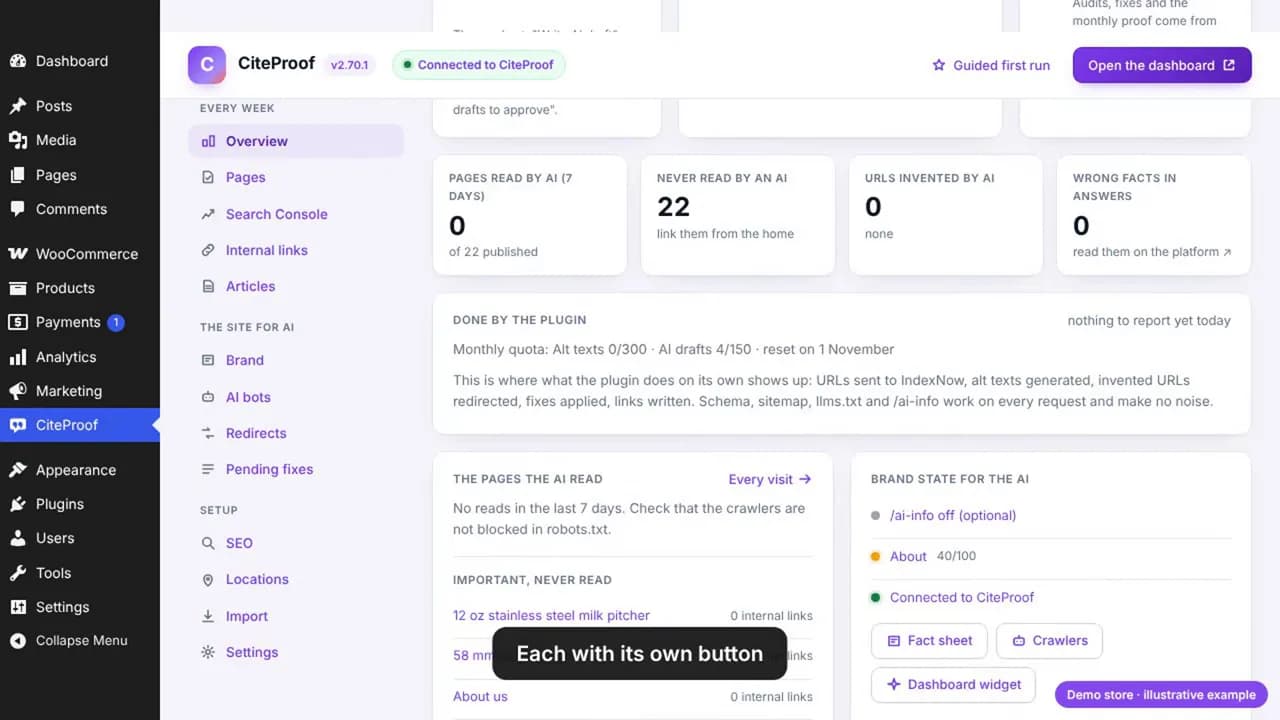
The plugin's Overview then lists what to do now, in order: fill in the fact sheet, complete the About page, set the AI crawlers. It also shows which pages the AI bots read this week, which important pages they have never read, and a button to link those pages from the ones that are read. The catalog (products, categories, pages) is sent to the dashboard, where the Store section scores it.
Step 2 · Measure your customers' questions
Before changing anything, get the facts. In the dashboard's Store section each category has two tracked questions, the ones shoppers actually type: "best coffee grinders 2026" and "how to choose coffee grinders", and the same pair for every other category. Measure now asks them to the AI engines of your plan and shows, engine by engine, whether the store is cited, with the date.
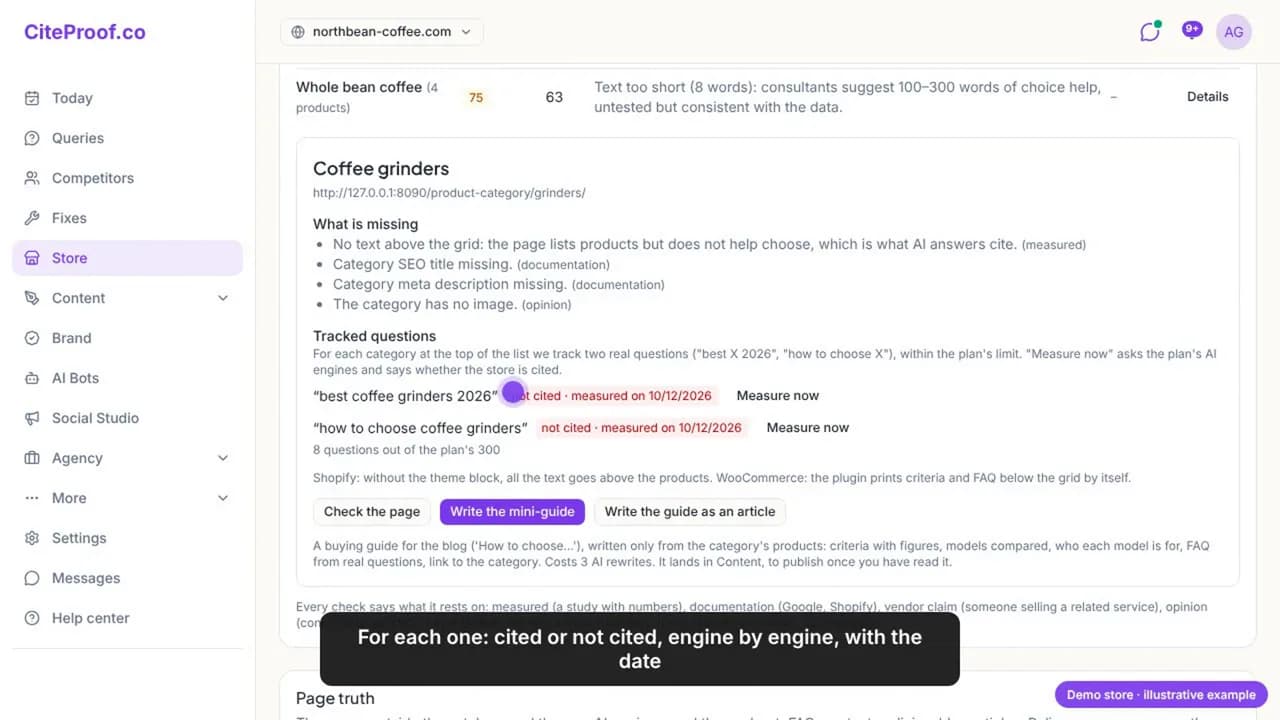
On the demo store the answer is not cited everywhere. That is the baseline. Every step that follows exists to change it, and the only way to know it changed is to measure the same questions again later.
Keep the dates. Citations move in weeks, not hours. A measurement without a date, or a question that changes from one month to the next, is not a measurement.
Step 3 · One identity: the fact sheet and the Organization schema
Before it recommends a store, an AI engine reads who you are: name, type of business, location, contacts, where your reviews and profiles live. On WordPress this often ends up written two or three times, by the theme, by an SEO plugin and by WooCommerce, with different names and no logo. Two identities that contradict each other read as "unclear" to a machine.
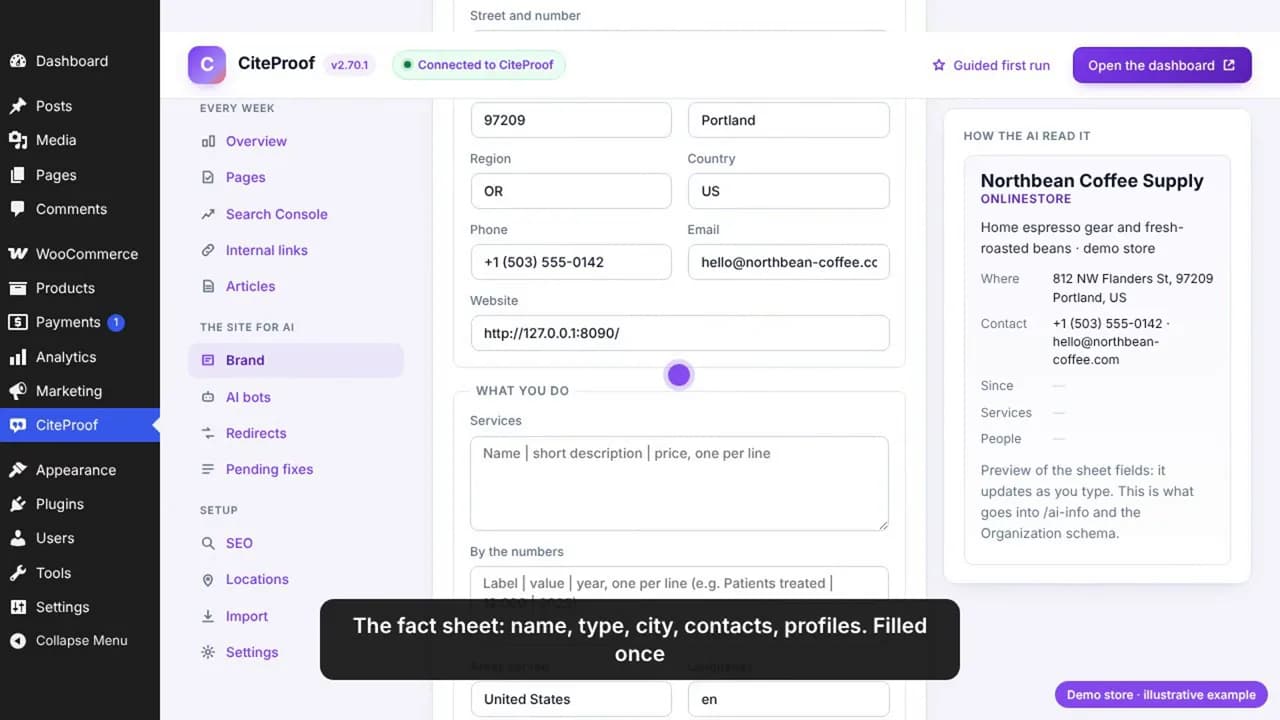
In the plugin, under Brand, you fill in the fact sheet once: name, legal name, type, founding year, address, phone, email, website, official profiles, Wikidata id if you have one. From that sheet the plugin:
- prints one
Organizationschema on every page, with the same facts everywhere; - checks that the site's pages agree with the sheet (Align entity to the sheet);
- can publish a small facts page (
/ai-info) with the same data in HTML, JSON-LD and Markdown.
Nothing is written to the theme files, and no second plugin should be writing a different Organization.
Step 4 · Let the right AI bots in
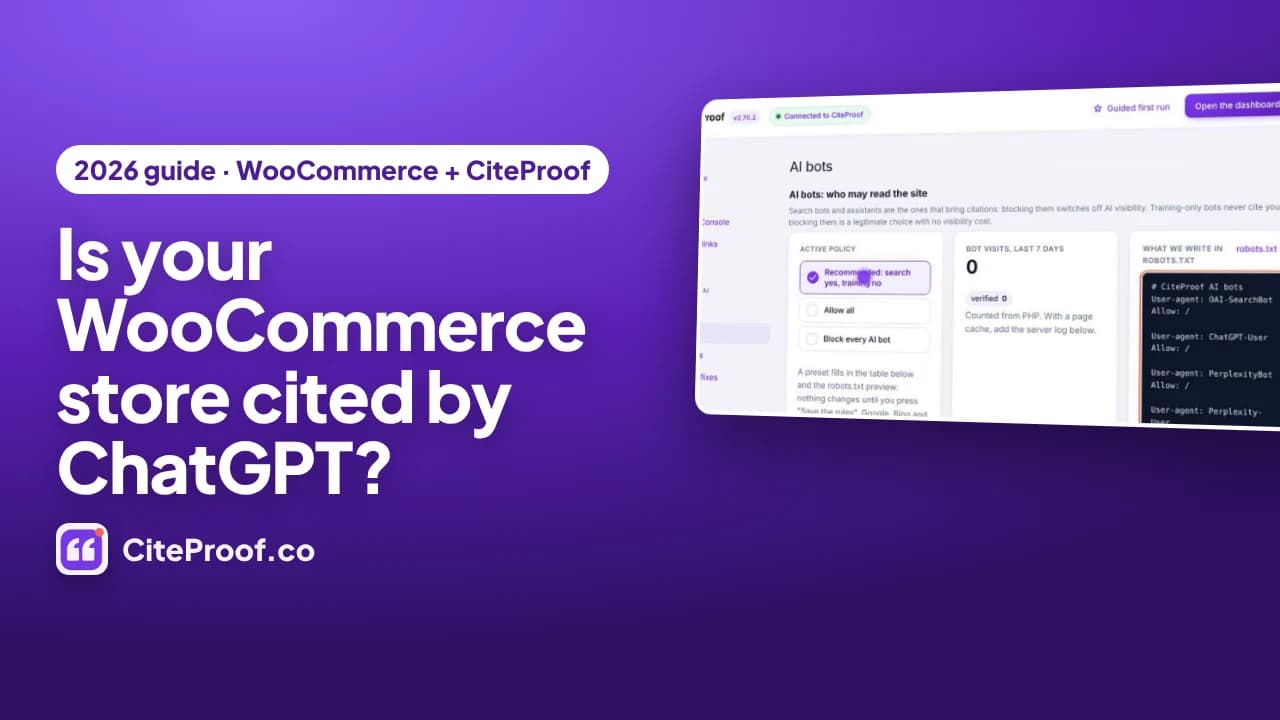
A store that blocks the AI crawlers cannot be cited, whatever else you fix. Under AI bots the plugin lists the bots it knows in two groups: the ones that bring citations (search and on-demand assistants: OAI-SearchBot, ChatGPT-User, PerplexityBot, Claude-SearchBot, Googlebot, Bingbot and others) and the ones that only train models (GPTBot, ClaudeBot, Google-Extended, CCBot and others). Blocking the first group switches off AI visibility; blocking the second is a legitimate choice with no visibility cost.
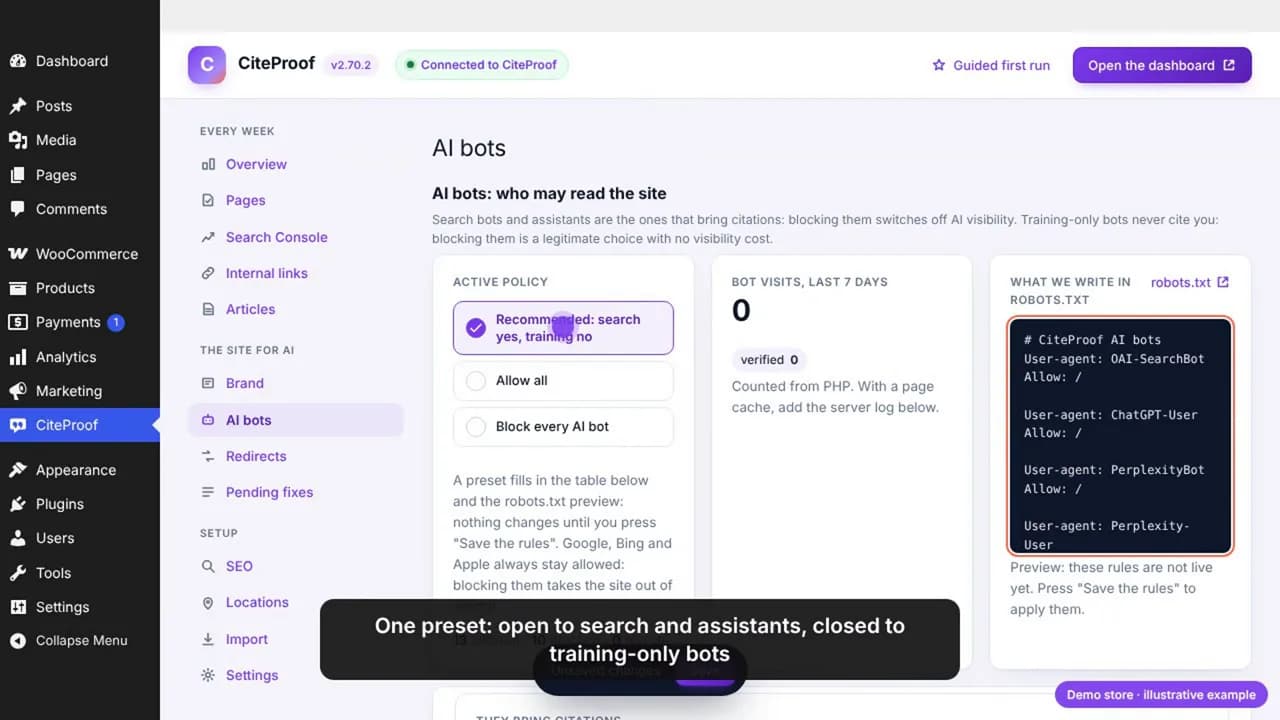
One preset, "search yes, training no", fills the table. The rules go into robots.txt only when you press Save, Google, Bing and Apple always stay allowed, and every visit by a bot is logged with the page and the time, so you can see who actually reads the store.
Step 5 · Product pages AI can understand
In the WooCommerce product list every product has its AEO score beside it. Open a product and the CiteProof · SEO box sits under the editor: the score, what is missing, the title and description proposed from real searches when Search Console is connected, and the Product schema the page prints.
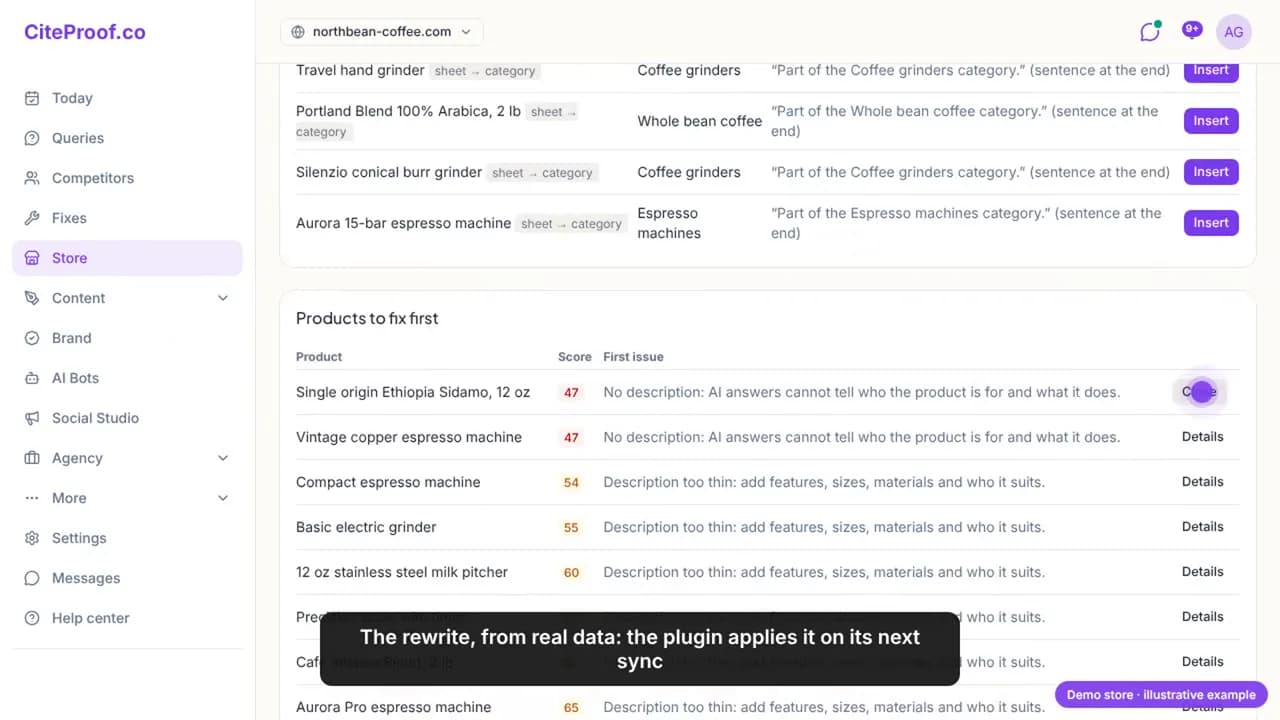
The dashboard goes further. Every product is scored on what the AI understands; on the demo store the weakest have no description, no GTIN and no alt text on the photos. To an AI engine a product like that barely exists. Open one and you get the rewrite, written only from the product's real data: what it is and for whom, features with figures, specifications, a short FAQ. No number that is not in your data. You read it, you apply it, and the plugin writes it to the product on its next sync; alt texts for the whole catalog are written the same way, one product at a time. Change your mind, and you undo.
A product page the engines can use has a factual description, a GTIN on every variant that has one, alt text on every photo, and Product JSON-LD that matches what the page shows.
Step 6 · Category pages: the buying guide
This is the step that moves citations the most. AI answers quote guides: how to choose, which model for whom, what to look for. A category page that is only a grid gives them nothing.
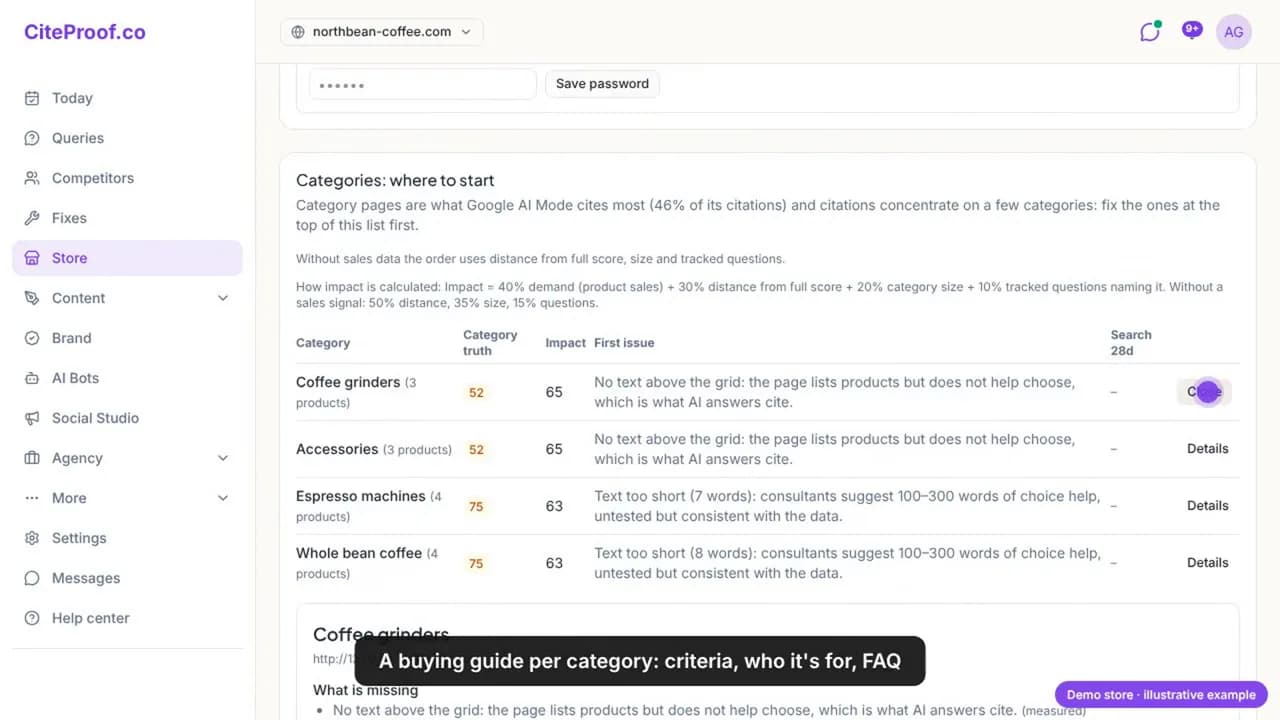
The dashboard ranks your categories by impact, so you know where to start, and writes a mini guide for each one using only your catalog:
- Choice criteria for that category (for grinders: burr type, grind settings, dose, noise, price range).
- Who each model is for, naming the products you actually sell.
- Frequently asked questions, taken from the tracked questions and from searches that land on the page.
One click, and the plugin prints criteria and FAQ under the product grid by itself, no theme block to add. Another click turns the guide into a blog article that links back to the category.
Step 7 · Returns and shipping, written from facts
Without a clear return policy, an AI engine will not recommend a store, and Google shows the policies right next to the price. The demo store has neither a return nor a shipping policy, so both are flagged as missing in the dashboard.
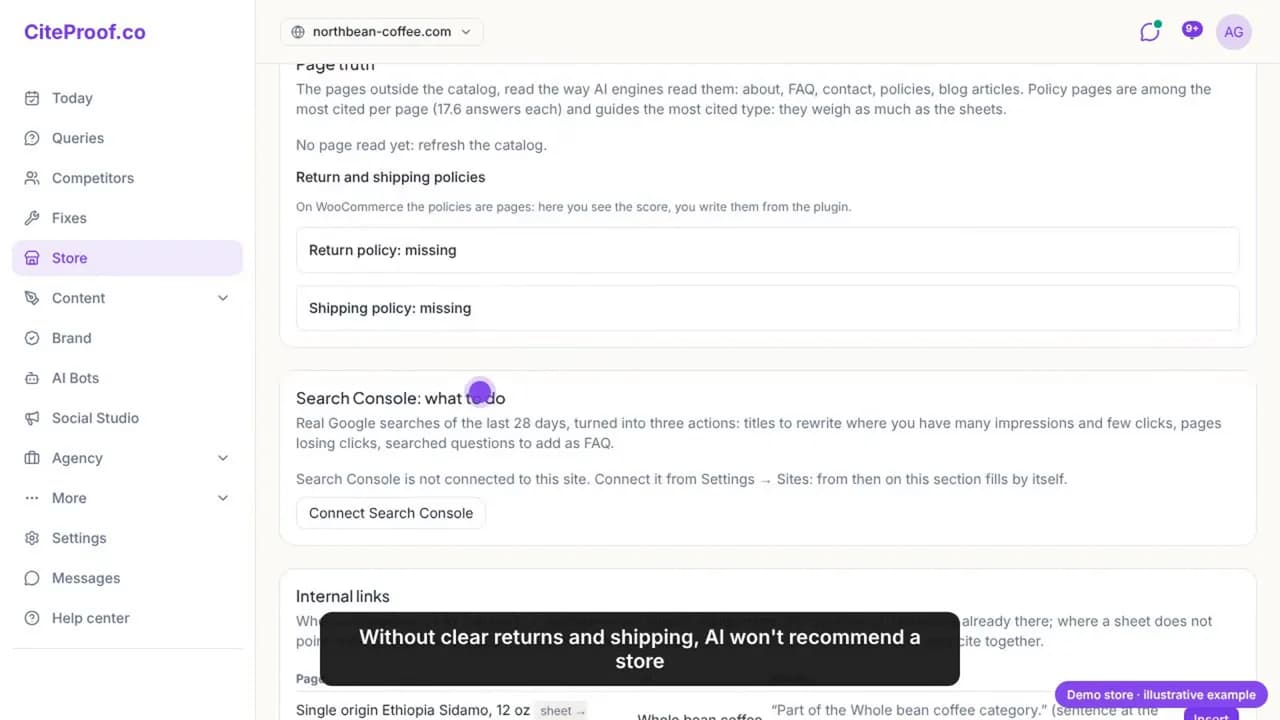
On WooCommerce you write them as pages, from facts, not adjectives: how many days to return, who pays for the return shipping, how and when the refund is made, delivery times and costs by destination. The plugin's SEO box on the page tells you whether the AI finds them clear, and the Organization schema links to them once they exist.
Step 8 · Internal links and the order of work
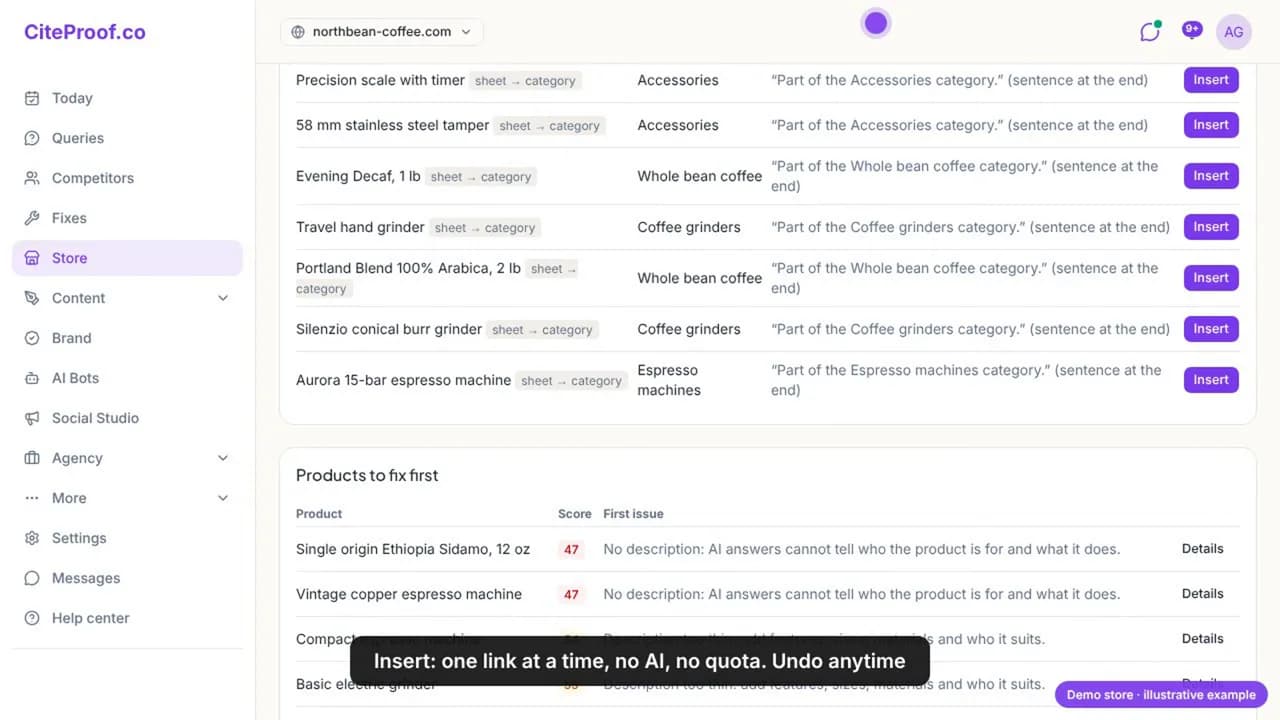
AI engines read pages in pairs: a product page that names its category without linking to it is a weaker source than one that does. The dashboard lists those pages with the sentence and the proposed link; you insert them one at a time, no AI involved, no quota used, and you can undo. In the plugin, Internal links finds the orphan pages, the ones nothing links to, and writes the link in the page that already covers the topic, on the phrase that is already there.
You do not need to do everything at once. The To do today list in the dashboard gives the three things that matter now, by weight: the policies and the identity of the store, the category to start from, the worst product page. Do those three, then come back. After each change, measure the questions again: the same question, the same engines, a new date. Measure once a month and keep the dates. That is the whole method: measure, fix what the AI reads, measure again.
See where your own store stands
The CiteProof free scan reads your WooCommerce store the way the AI engines do: identity, crawler access, product data, category pages, policies. You get the list of what to fix first, with no projections and no promises.
Frequently asked questions
Does WooCommerce already output the schema AI engines need?
WooCommerce prints a basic Product schema and WordPress prints none for the organization. What decides a citation is whether the data in that schema and on the page is complete and consistent: a two-line description, a missing GTIN or two conflicting Organization entities travel as they are. The plugin prints one Organization from the fact sheet and the WebPage, Article and FAQ schema on every page, and the dashboard scores the product data itself.
Will the plugin change my site without asking?
Not with manual approval on, which is the default. Every fix the dashboard proposes (schema, meta tags, llms.txt, robots.txt) waits in "Pending fixes" until you approve it, and an applied fix can be revoked. The rewrite of a product page is applied only after you read and accept it, and can be undone.
Should I block GPTBot and the other training crawlers?
It is your choice, and it costs nothing in visibility: training-only bots never cite you. What you must not block are the search and assistant bots (OAI-SearchBot, ChatGPT-User, PerplexityBot, Claude-SearchBot and the others in the "they bring citations" group), because those are the ones that read a page before an answer names it.
How do I check if ChatGPT already cites my WooCommerce store?
Ask it the questions your customers ask, one category at a time ("best X 2026", "how to choose X"), and note whether the store is named and which pages the answer links to. Repeat on Perplexity and Gemini and keep the date. The dashboard tracks these questions per category and measures them with one click.
How long does it take to see citations change?
Weeks, not hours. Engines re-read pages on their own schedule and Google AI Overviews follow the index. Measure the same questions once a month with the same engines and compare the dates.
Does this work without Search Console?
Yes. Search Console adds clicks, impressions and positions to the diagnosis and feeds the titles and FAQ with real searches; without it the plugin and the dashboard still score the pages, print the schema, write the guides and track the questions on the AI engines.
Read next
CiteProof tracks your brand's visibility across AI answer engines and tells you what to change to get cited. With one rule: the score only moves up after the Verify Bot confirms the fix is actually live.