How to Get Cited by Perplexity (Perplexity SEO)
How to get cited by Perplexity: what Perplexity says about its index, crawler and sources, what studies found, what you cannot control, how to check.
Perplexity answers a question by searching its own index of the web and writing a reply with numbered sources. To be one of those sources, your page has to be readable by its crawler, PerplexityBot, and it has to answer the question plainly. There is no form to submit a site and no ranking to buy. Perplexity names two criteria for choosing sources, authority and relevance, and publishes nothing more detailed. The rest of this guide is what Perplexity says, what studies measured, and what stays outside your control.
- Perplexity runs its own search index, which it says tracks more than 200 billion web addresses [2].
- Its documentation recommends allowing PerplexityBot in
robots.txtto "ensure your site appears in search results" [3]. - Of the assistants Ahrefs tested, Perplexity was the closest to Google: 28.6% of the pages it cited were in Google's top 10 for the same question [8].
- Its sources shift without notice. On one set of commercial questions, Reddit went from 20% of Perplexity's citations in early 2026 to 2% by July [10].
Want to know if AI assistants recommend your site? Free scan, about a minute →
"Perplexity SEO" is a phrase people search, and it promises more than exists. Perplexity has no results page with ten positions. It has an answer with a short list of sources, and the list changes. What a site owner can do is narrower than most guides suggest, and more concrete.
I build a tool that measures AI citations, Perplexity's included, so I have a stake in this. Every figure links to its source at the bottom with the date I opened it. Where a source sells software or services in this field (Ahrefs, Tinuiti, Meltwater, Yext, BrightLocal, Seer Interactive, SE Ranking), I say so.
Much of what Perplexity cites about a business is not the business's own site. Lesson 8.2 of the free AEO and GEO course covers where assistants look, in under three minutes:
How Perplexity builds an answer
Perplexity describes itself as an answer engine. Its help center gives the steps: it works out what you are asking, searches the web, summarizes what it finds and cites the sources. "Each answer includes numbered citations linking to the original sources" [1].
Three details from Perplexity's own engineering posts matter for a site owner.
It has its own index. "Our search index tracks over 200 billion unique URLs", the company wrote in 2025 [2]. Appearing in Google or Bing does not put you in it; Perplexity's crawler has to reach you.
It reads pages in pieces. Perplexity says it splits documents into "self-contained spans, each of which can be individually retrieved and ranked" [2]. A paragraph that answers one question well can be picked up without the rest of the page.
It does not crawl on a schedule. The web, it says, is "far too vast to index every single URL on a frequent and recurring basis", so a model decides which addresses need indexing, "prioritizing documents from authoritative domains" among other things [2]. There is no published timetable for when a new page is picked up.
How it chooses sources
The only plain statement Perplexity makes is short: "our answer engine ranks sources based on authority and relevance" [5]. It has said it does not want a tactics industry to form around that: "we will avoid duplicating the SEO industry where people are implementing arbitrary tactics to improve their rankings at the expense of user utility" [7].
Since 2026 some citations carry a small label: Government, Academic or Trusted. Perplexity says it "rates the whole website a source comes from, not each individual page", that payments and partnerships do not affect a label, and that most sites have none [6]. It does not say that a label makes a site more likely to be cited, and there is no form to apply for one.
On advertising, Perplexity's stated position is that answers "will not be influenced by advertisers" [7].
Step 1: let PerplexityBot in
This is the one instruction Perplexity gives site owners, and it is the first thing to check.
Perplexity uses two agents [3]:
| Agent | What Perplexity says it does | robots.txt |
|---|---|---|
| PerplexityBot | "is designed to surface and link websites in search results on Perplexity"; not used to train models | Obeys it |
| Perplexity-User | Visits a page when a user's question needs it | "generally ignores robots.txt rules", because a person asked |
Its documentation recommends "allowing PerplexityBot in your site's robots.txt file and permitting requests from our published IP ranges", and notes that changes can take up to 24 hours to apply [3].
Two things go wrong here more often than a robots.txt rule.
The firewall. A site can allow PerplexityBot in robots.txt and still turn it away at the door. Perplexity's own page warns that Cloudflare's Bot Fight Mode can challenge its bots even when an allow rule exists [3]. If your site sits behind a protection service, check there as well.
Blocking does less than you might think. If you do want to stay out, Perplexity says PerplexityBot will not index the text of a blocked page, but "we may still index the domain, headline, and a brief factual summary" [4].
For the full picture across assistants, see which AI crawlers to let in. The free AI visibility check tests whether PerplexityBot and the other bots can reach your site.
Step 2: put the content in the page itself
Perplexity has not said whether its crawler runs JavaScript. An outside measurement suggests it does not: Vercel, analyzing traffic on its own network, found that "none of the major AI crawlers currently render JavaScript", PerplexityBot among them [18]. That data is from late 2024, so treat it as a caution, not a current fact. The safe choice is that prices, descriptions and answers are in the HTML the server sends.
Step 3: answer one question per section, plainly
Because Perplexity ranks passages as well as pages, the unit that gets cited is often a paragraph. A heading that states the question, an answer in the first lines, and the facts a careful reader would want: this is the same advice as for any assistant, and Perplexity's own description of how it reads pages is the reason it applies here.
Ranking well on Google helps more here than with other assistants. In Ahrefs' test of 15,000 questions, 28.6% of the pages Perplexity cited were in Google's top 10 for the same question, against roughly 8% for the others [8]. Ahrefs sells SEO software, and the questions were long and specific.
Step 4: be where Perplexity looks for businesses
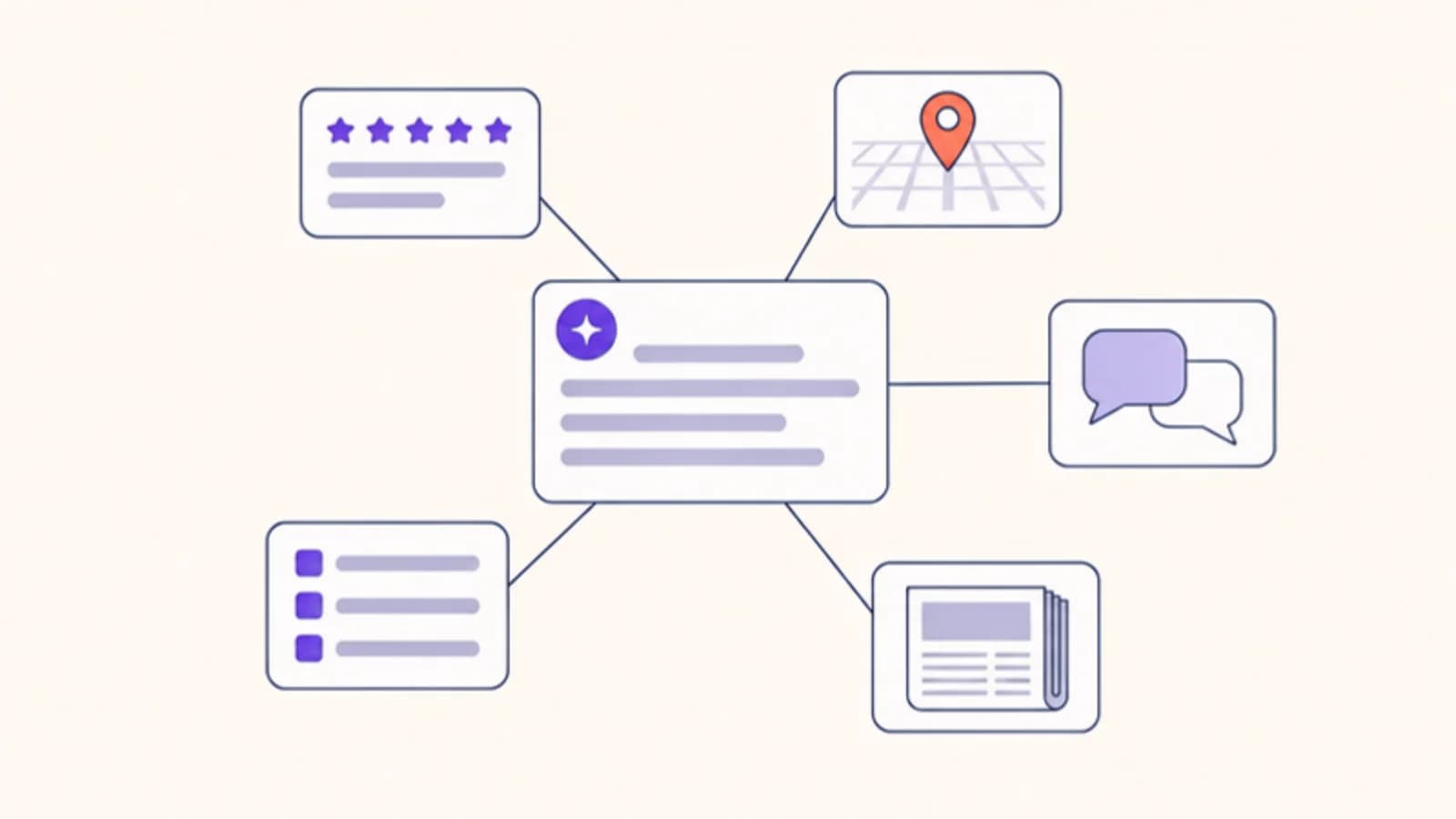
For questions about businesses and places, the sources are often directories and review sites, and the studies do not agree on which.
- Yext, which sells listings software, looked at 6.8 million citations gathered through the assistants' developer interfaces. It found that Perplexity "diversifies its sources, favoring MapQuest for listings" and TripAdvisor for reviews [12].
- BrightLocal, which sells local marketing tools, ran a small test of 20 searches in 10 industries: "Perplexity notably used Yelp in every single industry we investigated" [13].
Neither settles the question, and both sell services tied to listings. What they agree on is the practical part: a business with complete, matching entries on the main directories in its field gives Perplexity more places to find the same facts.
For shops, Perplexity says its answer engine "is more likely to recommend merchants who provide deeper product details such as availability, reviews, pricing, and specifications" [5]. Its in-chat buying feature is available only in the United States for now [5].
What the studies say about its sources
Which sites it cites most. In Ahrefs' list for November 2026, built on more than 3.1 million US questions, the three most-cited sites were Reddit, YouTube and Wikipedia [9]. The list is recalculated every month.
How much that moves. Tinuiti tracks a fixed set of commercial questions. On that set, Reddit fell from 20% of Perplexity's citations in the first quarter of 2026 to 2% by July [10]. Different questions give different shares, which is why the figures from one study should not be set against another.
How many sources an answer shows. Meltwater observed that "Perplexity began listing at most 10 sources around 6 October" 2026, down from about 24 [11]. Fewer places in the list means each one is harder to win.
Whether it prefers recent pages. The evidence points both ways. Seer Interactive found that about half of Perplexity's citations with a readable date were from the current year, in a mid-2025 sample of some 5,000 addresses across three engines [14]. Ahrefs, on a far larger set, found that the pages Perplexity cites in its text were older on average than those ChatGPT cites [15]. Keep pages accurate; do not expect a date change to earn a citation.
What you cannot control
- There is nothing to submit. I found no submission form, no console for site owners and no statement about sitemaps in Perplexity's help center or documentation.
- There is no position to hold. The list of sources changes with the question, the person and the day.
- The partner programmes are not open to everyone. Perplexity has revenue-sharing arrangements with publishers and a merchant programme, both by admission.
- Its crawling has been disputed. In August 2025 Cloudflare reported that when Perplexity's declared crawler was blocked, it appeared to "obscure their crawling identity" [19]. Perplexity rejected the report, saying Cloudflare had confused it with traffic from a third-party browser service that it used for "less than 45,000 daily requests" [20]. Both statements are on the record; I cannot tell you which is right.
How big is Perplexity, really?
Smaller than its reputation among marketers suggests, and worth knowing about anyway.
Perplexity's chief executive said it received 780 million queries in May 2025 [17]. I found no first-hand figure for 2026.
As a source of visits it is modest. SE Ranking looked at 101,574 websites with analytics connected: in the first four months of 2026, Perplexity sent 7.23% of the visits that came from AI assistants, behind ChatGPT and Gemini [16]. As a share of all traffic to those sites, it was 0.0230% [16].
So the reason to care is the same as for any assistant: not the visits, but whether your name is in the answer when someone asks.
How to check whether Perplexity cites you
Ask it. Every answer shows its numbered sources, so the check is direct: ask the questions your customers ask, without your name in them, and read the list. Do it more than once and write the date. The method, with a worksheet, is in how to run an AI visibility audit.
Look for the visits. Clicks from Perplexity usually arrive with perplexity.ai as the source. Google Analytics has an "AI Assistant" channel for visits from "sources like ChatGPT, Gemini, Deepseek, Copilot, or Grok" [21]. Google's page does not name Perplexity, so look in your own reports for perplexity.ai and see which channel it lands in.
Read your server logs. The two agents identify themselves, and Perplexity publishes the addresses they come from [3]. PerplexityBot is the index crawler; Perplexity-User is a visit made for someone's question.
Perplexity gives ordinary site owners no report of their citations. I looked for one and found none.
See which assistants name you, and who they name instead
Start with the free scan on ChatGPT, Perplexity and Gemini. The paid plans repeat the same customer questions on five engines at every audit and save the sources each answer cited.
A measurement, not a promise: no one can make a citation certain.
Frequently asked questions
What is Perplexity SEO?
It is the common name for the work of getting a site cited in Perplexity's answers. There is no ranking to optimize: Perplexity writes an answer and lists a few sources, chosen, in its own words, on authority and relevance.
How do I get my website on Perplexity?
Let its crawler, PerplexityBot, read your site: check robots.txt and any firewall or protection service. There is no form to submit a site. After that, pages that answer a question plainly, in text, are the ones it can use.
Does Perplexity use Google or Bing?
Perplexity says it runs its own search index. In one study, the pages it cited overlapped with Google's top results more than those of other assistants, but being in Google does not put a page in Perplexity's index.
How long does it take for Perplexity to pick up a new page?
Perplexity publishes no timetable. It says a model decides which pages to index and how often. The only timing it gives is for robots.txt changes: up to 24 hours.
Can I pay to appear in Perplexity's answers?
No. Perplexity says its answers are not influenced by advertisers and that product listings cannot be bought.
Does Perplexity cite Reddit?
Yes, and how much varies. Reddit was the most-cited site in one large US list for November 2026, while on a fixed set of commercial questions its share fell sharply during 2026. The answer depends on the kind of question.
Can I block Perplexity?
You can disallow PerplexityBot in robots.txt, and Perplexity says it will not index the text of blocked pages. It may still index the domain, the headline and a brief factual summary, and the agent that fetches a page for a user's question generally ignores robots.txt.
Sources
- [1] How does Perplexity work? · Perplexity Help Center · November 2026 · accessed 2026-11-25
- [2] Architecting and Evaluating an AI-First Search API · Perplexity · September 2025 · accessed 2026-11-25
- [3] Perplexity Crawlers · Perplexity · November 2026 · accessed 2026-11-25
- [4] How does Perplexity follow robots.txt? · Perplexity Help Center · September 2026 · accessed 2026-11-25
- [5] What is Instant Buy? · Perplexity Help Center · October 2026 · accessed 2026-11-25
- [6] Understanding source labels · Perplexity Help Center · October 2026 · accessed 2026-11-25
- [7] Why we're experimenting with advertising · Perplexity · November 2024 · accessed 2026-11-25
- [8] Only 12% of AI Cited URLs Rank in Google's Top 10 for the Original Prompt · Ahrefs · August 2025 · accessed 2026-11-25
- [9] The 50 Most-Cited Websites in Perplexity · Ahrefs · November 2026 · accessed 2026-11-25
- [10] AI Citations in 2026: 4 Findings Every Brand Should Know · Tinuiti · November 2026 · accessed 2026-11-25
- [11] AI search visibility report: October 2026 findings · Meltwater · November 2026 · accessed 2026-11-25
- [12] AI Citations, User Locations, & Query Context · Yext · October 2025 · accessed 2026-11-25
- [13] AI Search Makes Local Listings More Important Than Ever · BrightLocal · July 2025 · accessed 2026-11-25
- [14] Study: AI Brand Visibility and Content Recency · Seer Interactive · June 2025 · accessed 2026-11-25
- [15] New Study: AI Assistants Prefer to Cite "Fresher" Content (17 Million Citations Analyzed) · Ahrefs · July 2025 · accessed 2026-11-25
- [16] Analysis of Top AI Search Engines: Who Is Catching Up to ChatGPT? · SE Ranking · June 2026 · accessed 2026-11-25
- [17] Perplexity received 780 million queries last month, CEO says · TechCrunch · June 2025 · accessed 2026-11-25
- [18] The rise of the AI crawler · Vercel · December 2024 · accessed 2026-11-25
- [19] Perplexity is using stealth, undeclared crawlers to evade website no-crawl directives · Cloudflare · August 2025 · accessed 2026-11-25
- [20] Agents or Bots? Making Sense of AI on the Open Web · Perplexity · August 2025 · accessed 2026-11-25
- [21] Default channel group · Google Analytics Help · 2026 · accessed 2026-11-25
Read next
- AEO · Answer Engine OptimizationWhat Is AEO? Answer Engine Optimization Explained
- GEO and AEO · FundamentalsGEO vs SEO vs AEO: What Is the Difference?
- AEO · Google AI OverviewsHow to Appear in Google AI Overviews (2026 Guide)
CiteProof tracks your brand's visibility across AI answer engines and tells you what to change to get cited. With one rule: the score only moves up after the Verify Bot confirms the fix is actually live.