Query Fan-Out: What It Is and What It Means for You
Query fan-out: an AI system turns one question into several searches and answers from all of them. What Google says, what was measured, what to do.
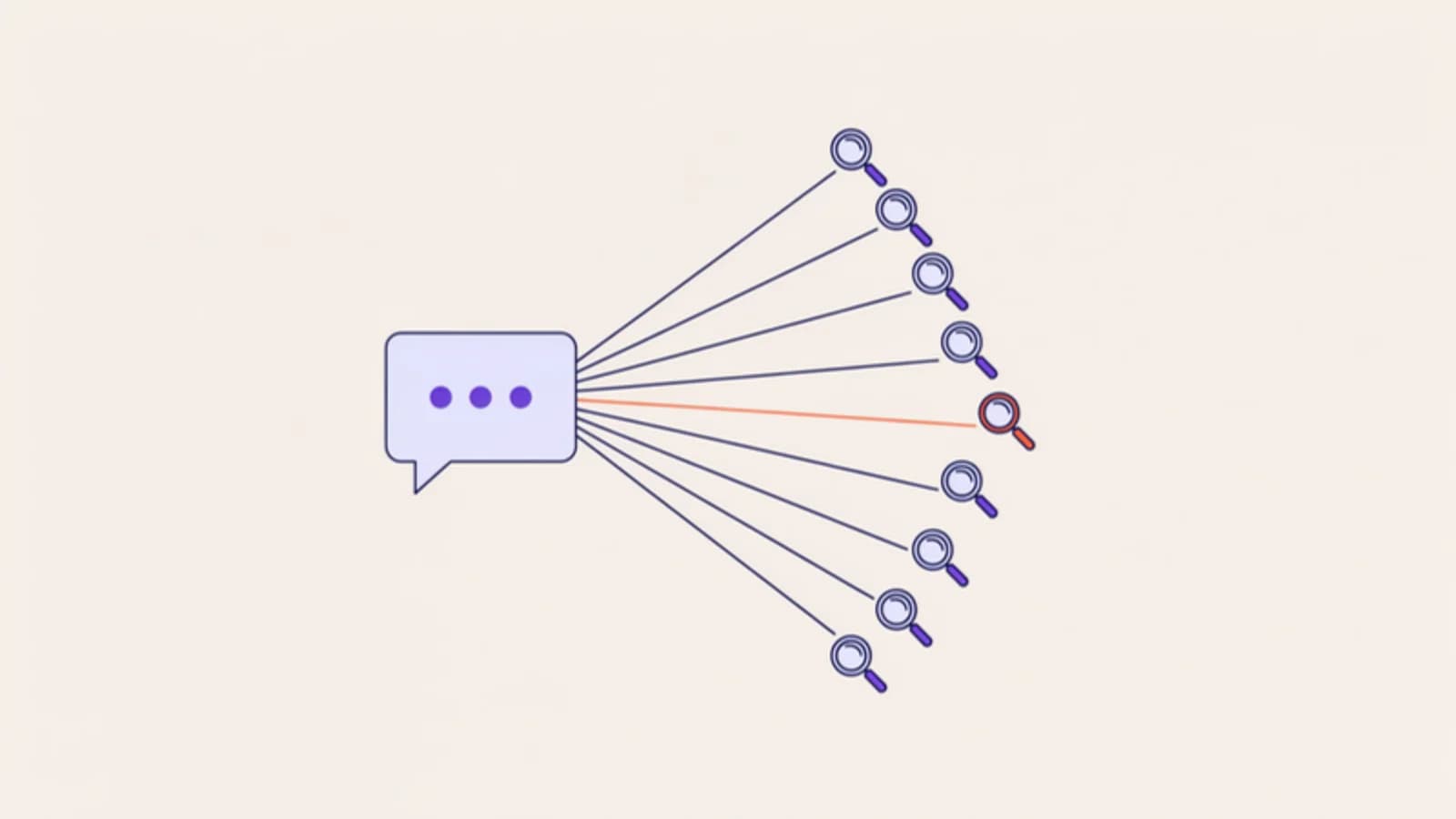
Query fan-out is what an AI search system does with your question before it answers: it breaks the question into several related searches, runs them at the same time, and writes one answer from everything it finds. Google uses the term for AI Mode and AI Overviews; ChatGPT and other assistants do something similar. For a site owner it means a page can be cited for a search nobody typed, and that you cannot see the list of those searches.
- Google's own description of AI Mode: "issuing a multitude of queries simultaneously on your behalf" [2].
- The searches change from run to run. In one test, 100 questions were each asked 13 times, and only 8 of the generated searches appeared in all 13 runs [11].
- Google's Search Console report on AI answers lists pages, countries, dates and devices. It does not list the searches [15].
- Google warns against building a separate page for every variation of a search [5].
Want to know if AI assistants recommend your site? Free scan, about a minute →
Search for something on Google and you used to get results for those words. Ask an AI system the same thing and it first decides what else it needs to know. "Best running shoes for flat feet" becomes a search for how flat feet affect running, another for which shoes give support, another for recent reviews. The answer you read is assembled from all of them. That step is called query fan-out.
It matters because it changes what "ranking for a search" means. This guide separates three things that most articles on the subject blend together: what Google and OpenAI have said, what has been measured and how, and what is guesswork. I build a tool that measures AI citations, so I have a stake in the topic; every figure links to its source at the bottom with the date I opened it, and the companies that sell software or services (Ahrefs, Profound, Surfer, Semrush, seoClarity, Seer Interactive, Nectiv) are marked where I use them.
The practical answer to fan-out is a site organized around topics instead of single keywords. Lesson 6.3 of the free AEO and GEO course shows how in under three minutes:
What query fan-out is, in Google's words
Google used the term publicly at least as early as March 2025, when it launched AI Mode as an experiment. It said AI Mode uses "a 'query fan-out' technique, issuing multiple related searches concurrently across subtopics and multiple data sources", and then brings the results together [1].
At its developer conference two months later, the head of Google Search put it this way: AI Mode works by "breaking down your question into subtopics and issuing a multitude of queries simultaneously on your behalf" [2].
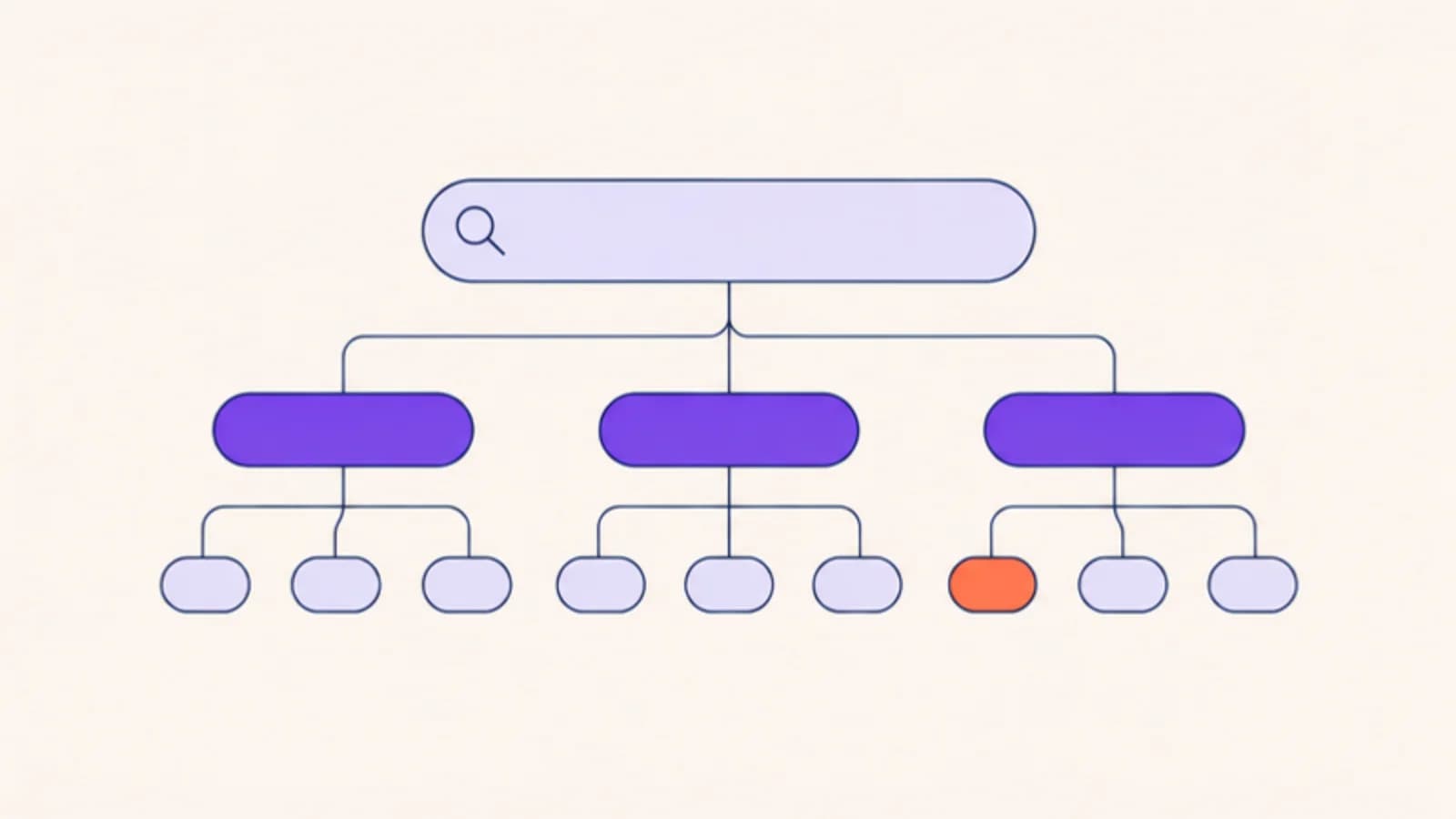
Google's guide for site owners gives the definition and an example. Fan-out is "a set of concurrent, related queries generated by the model", and for the search "how to fix a lawn that's full of weeds" the related searches might include "best herbicides for lawns", "remove weeds without chemicals" and "how to prevent weeds in lawn" [5].
The second step is the fan-out. The person asking never sees it, and neither does the site owner.
Both of Google's AI features can do this, though not in the same way: Google says "AI Mode and AI Overviews may use different models and techniques, so the set of responses and links they show will vary" [4].
How many searches is that?
Google has never published a number. What it has said is loose. A Google engineering director described AI Mode as "basically doing a dozen searches for you in the time it takes to do one" [3]. For Deep Search, the long-form research feature, Google said it "can issue hundreds of searches" [2]. Both are figures of speech from named people, not specifications.
Independent measurements exist, and they disagree because they measure different things:
| Who measured | What they looked at | Searches per question |
|---|---|---|
| Ahrefs | 66.6 million answers from free, logged-out ChatGPT, August to September 2026 | About 1.6, in the 14.4% of answers that searched at all |
| Profound | 10,000 questions on ChatGPT, Perplexity and Copilot, 14 days in spring 2026 | About 1.4 to 2 |
| Nectiv | About 4,000 questions through OpenAI's developer interface, 2026 | 7.61 on average |
The rows come from Ahrefs [8], Profound [9] and Nectiv [10]. The gap between the first two and the third is mostly method: the consumer product on everyday questions searches far less than the developer interface does when it is asked to search.
One limit applies to every number about Google. No study I could open captured the searches that AI Mode or AI Overviews actually run. The "Google" figures in circulation come from Google's developer tools, which are a stand-in, and Google's own documentation says the list those tools return can be incomplete: "Extra queries the model runs during reasoning might not appear here" [7].
Other assistants do it too
OpenAI describes the same step for ChatGPT search: when it works with other search providers, it "typically rewrites your query into one or more targeted queries" [6]. The name differs, the idea is the same: the words you typed are not the words that get searched.
The searches change every time
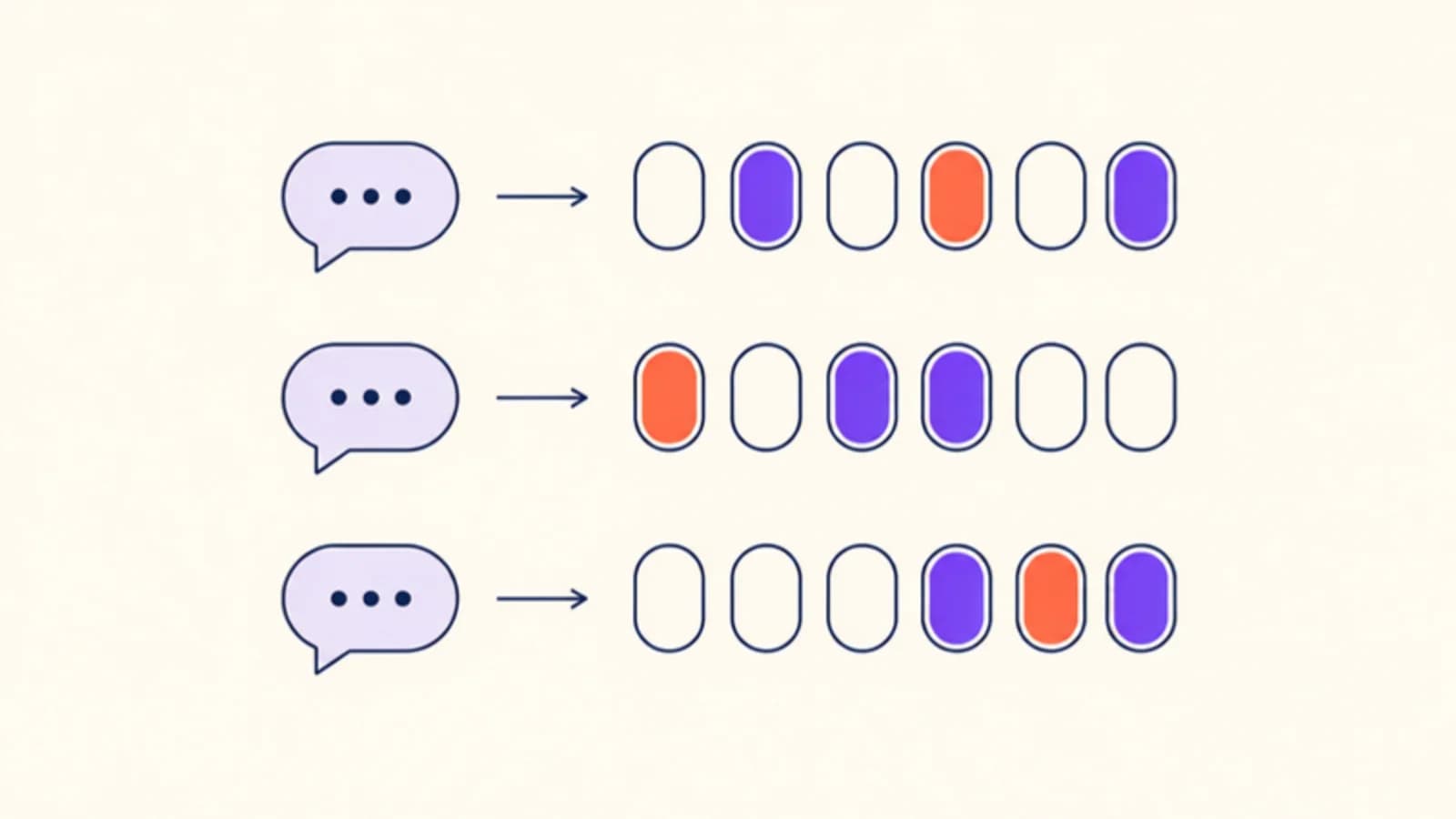
This is the finding that should shape what you do, and three separate measurements agree on it.
- Seer Interactive asked 100 questions 13 times each through Google's developer tools and collected 11,029 different generated searches. "Only 8 queries appeared in all 13 runs" [11].
- Surfer, across 1,600 runs of the same kind, found that only about 27% of the generated searches "stayed consistent across repeated runs of the same prompt" [12].
- Profound found that 91% of the searches ChatGPT ran were unique: the same question, asked again, almost never produced the same search string [9].
The topics stay close even when the wording moves. That is why trying to "rank for the fan-out queries" one by one is a moving target, and why the unit that matters is the topic.
Why a page is cited for a search it does not rank for
Fan-out is the most likely explanation for a number that puzzles people who do SEO well. In Ahrefs' March 2026 study, 37.9% of the pages cited in Google's AI Overviews were in the top 10 for the search itself; the rest came from somewhere else [13]. seoClarity looked at AI Mode on 1,000 shopping-type searches and found that just 19% of its citations came from the top 20 results [14].
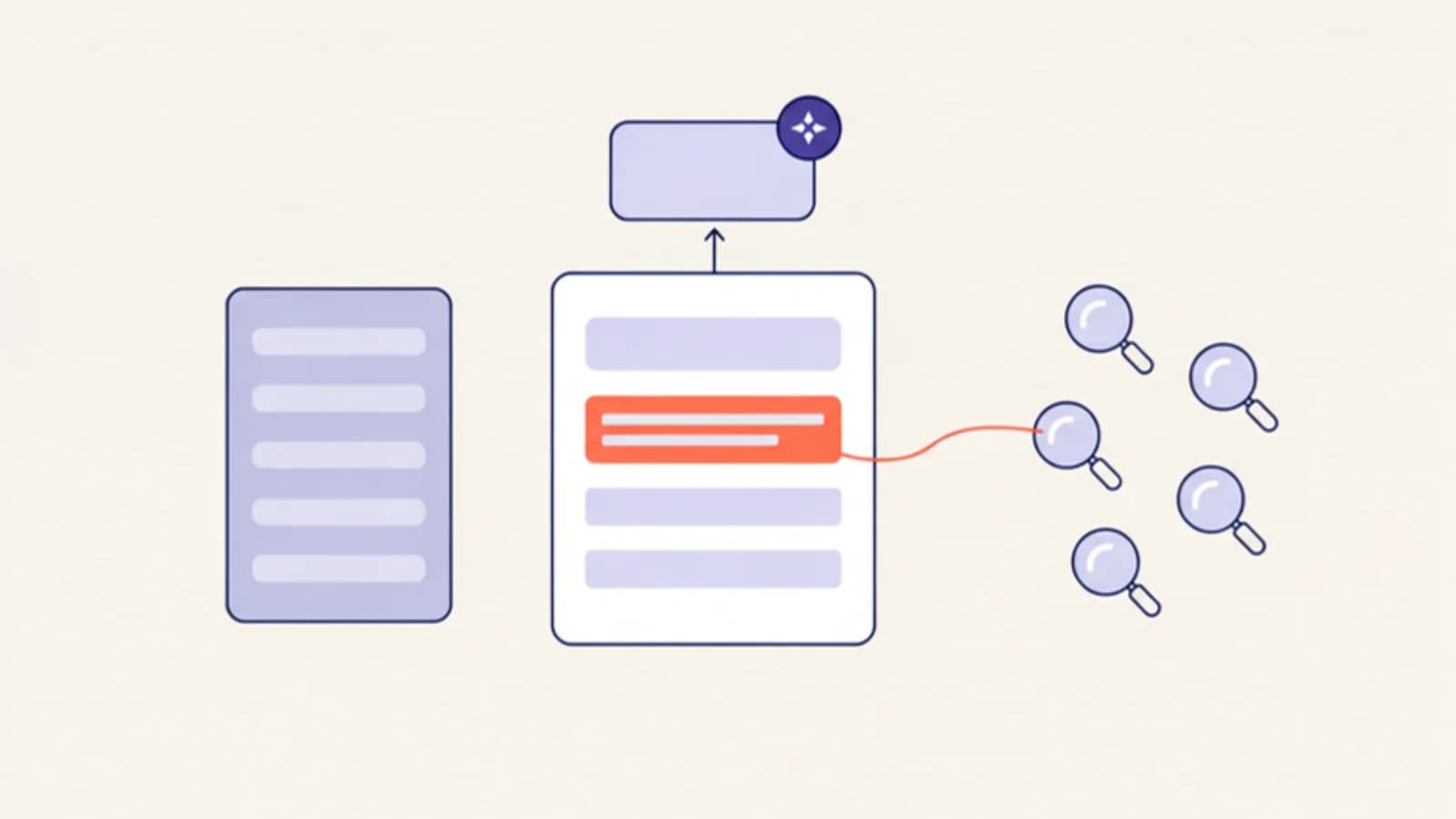
Both companies attribute the gap to fan-out: the cited pages rank for one of the related searches. It is a reasonable reading, and it is still an inference. As Ahrefs puts it, "Google doesn't expose the simulated fan-out queries they generate for each AI response" [13].
The closest thing to direct evidence is Surfer's study of 10,000 keywords. Among cited pages that ranked, 51.2% ranked for the main search and at least one related search, against 19.6% for the main search alone [12]. Two cautions come with it: the related searches were generated by asking a model, not captured from Google, and Surfer itself labels the result "Correlation, not causation".
Can you see the fan-out searches for your site?
Mostly no.
- Google Search Console has a report for AI Overviews and AI Mode. It shows impressions by page, country, date and device [15]. There is no list of searches.
- Google's developer tools return the searches a model ran for a question you send. It is a proxy for what Search does, and Google says the list can be incomplete [7].
- Tools that claim to show "Google's fan-out queries" are generating plausible ones with a model. That can be useful for ideas. It is not a record of what Google searched.
Semrush ran a small test of optimizing for fan-out and described the problem plainly: with no way to know which related searches Google would use, "I had to rely on synthetic queries" [16].
What to do about it
1. Think in topics, not in single searches. If you sell garden services, the question "how much does lawn care cost" brings with it what is included, how often it is needed, and what changes the price. A page, or a small group of linked pages, that covers the questions around your main one is a candidate for more of the searches behind an answer.
2. Answer the next question on the page. After reading your answer, what would a customer ask? Put that on the page under its own heading, with a direct answer in the first lines.
3. Make each section stand on its own. A system that searched for one sub-question lifts the passage that answers it. A section that only makes sense after reading the three before it is harder to use.
4. Do not mass-produce pages for every variation. Google is explicit: creating separate content for every possible variation of a search, or for every fan-out query, mainly to manipulate results, falls under its policy on scaled content abuse [5]. Ten thin pages for ten phrasings is the wrong lesson to draw from fan-out.
5. Measure the result, not the searches. You cannot see the fan-out. You can see whether the answer names you. Ask the assistants the questions your customers ask, several times, and write down what comes back: the method is in how to run an AI visibility audit.
For Google's AI answers in particular, see how to appear in Google AI Overviews. For the wider picture, see what generative engine optimization is.
Find out whether the answer includes you
Start with the free scan. The paid plans ask the same customer questions on five engines at every audit, save the sources each answer cited, and show who was cited instead of you.
A measurement, not a promise: no one can make a citation certain.
Frequently asked questions
What is query fan-out in simple terms?
When you ask an AI search system a question, it writes several related searches of its own, runs them at once, and builds one answer from the results. Fan-out is that step of turning one question into many searches.
Who invented the term query fan-out?
Google uses it for its AI search features. The earliest public use I could find is its announcement of AI Mode in March 2025.
How many fan-out queries does Google run?
Google has not published a number. A Google engineer described AI Mode as doing about a dozen searches in the time of one, and Google said Deep Search can run hundreds. Independent figures come from developer tools, not from Google Search itself.
Does ChatGPT use query fan-out?
Yes, under another name. OpenAI says ChatGPT search typically rewrites a question into one or more targeted queries. Measurements on the consumer product found one to two searches per question when it searches at all.
Can I see which fan-out queries led to my page being cited?
No. Search Console reports impressions in Google's AI answers by page, not by search, and Google does not publish the related searches it generates.
How do I optimize for query fan-out?
Cover the questions around your main topic, answer each one directly under its own heading, and link the pages to each other. Do not create a separate page for every phrasing: Google treats that as scaled content abuse.
Is query fan-out the same for everyone?
No. The generated searches change from one run to the next, and OpenAI says ChatGPT may use what it remembers about a person when it rewrites a search. That is one reason a single check of an AI answer says little.
Sources
- [1] Expanding AI Overviews and introducing AI Mode · Google, The Keyword · March 2025 · accessed 2026-11-25
- [2] AI Mode in Google Search: Updates from Google I/O 2025 · Google, The Keyword · May 2025 · accessed 2026-11-25
- [3] Google expert explains AI Mode in Search's query fan-out method · Google, The Keyword · March 2026 · accessed 2026-11-25
- [4] AI Features and Your Website · Google Search Central · December 2025 · accessed 2026-11-25
- [5] Google's Guide to Optimizing for Generative AI Features on Google Search · Google Search Central · May 2026 (updated July 2026) · accessed 2026-11-25
- [6] Searching the web with ChatGPT · OpenAI Help Center · 2026 · accessed 2026-11-25
- [7] Grounding with Google Search (Gemini API documentation) · Google · 2026 · accessed 2026-11-25
- [8] How ChatGPT Does Query Fan-Out (15 Million Queries Studied) · Ahrefs · October 2026 · accessed 2026-11-25
- [9] What AI engines actually search for and why ChatGPT never searches the same way twice · Profound · April 2026 · accessed 2026-11-25
- [10] What We Learned From Analyzing 28K+ ChatGPT And Gemini Fan-Out Queries · Nectiv · August 2026 · accessed 2026-11-25
- [11] Identifying Signal from Noise: 6 Ways to Leverage Query Fan Outs for AI Search Strategy · Seer Interactive · January 2026 · accessed 2026-11-25
- [12] Query Fan-Out: What It Is, How It Works, and How to Optimize for It · Surfer · September 2026 · accessed 2026-11-25
- [13] Update: 38% of AI Overview Citations Pull From The Top 10 · Ahrefs · March 2026 · accessed 2026-11-25
- [14] Do Better Google Rankings Translate to AI Mode Visibility? · seoClarity · October 2025 · accessed 2026-11-25
- [15] Generative AI performance report (Search) · Google Search Console Help · 2026 · accessed 2026-11-25
- [16] We Tested Query Fan-Out Optimization (Here's What We Learned) · Semrush · September 2025 · accessed 2026-11-25
Read next
- AEO · Answer Engine OptimizationWhat Is AEO? Answer Engine Optimization Explained
- GEO and AEO · FundamentalsGEO vs SEO vs AEO: What Is the Difference?
- AEO · Google AI OverviewsHow to Appear in Google AI Overviews (2026 Guide)
CiteProof tracks your brand's visibility across AI answer engines and tells you what to change to get cited. With one rule: the score only moves up after the Verify Bot confirms the fix is actually live.